Chapter Twenty-Five
The family ledger
"I think before developing you should think about plan, do some research on ux
and flow by other big companies like Orange, Jio and the Nordic CSPs… because I really want to give a good user
experience for end customers." — the operator, pulling the handbrake
The household had started as billing plumbing: a person could pay for another
person, consent-gated, one family bill with per-person attribution. Correct, tested, honest — and
not an experience. The operator's own click-through proved it. Two subscriptions on a page with no
hint of whose they were; a link that promised "open their page" and opened the wrong one, because
a login redirect quietly dropped the deep link on the floor. The bug was one line. The verdict was
bigger: stop patching, go read how the operators people actually live with present a family.
So the research came first, for once, and it converged fast. Jio's parent SIM is a hub — the
parent's app lists every linked number and drills into each one, and adding a member sends the OTP
to their phone, consent built into the gesture. Orange lets a second parent co-pilot the
children's accounts. Verizon has the cleanest role grammar in the industry: one Owner, up to three
Account Managers who can do nearly everything except manage each other, Members who see only their
own line. T-Mobile's Family Allowances let the owner set caps the managed lines can see but not
change. And Google's Family Link solved the purchase question years ago: the child taps "buy", the
parent gets the ask, nobody hits a dead end. None of them scatter labels across the member's own
page. All of them build a family place.
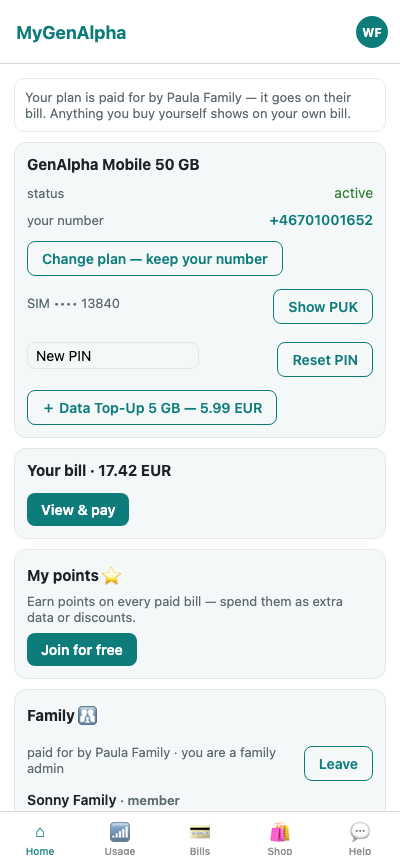
The family hub followed in three phases, each shipped against a live suite. Phase one was the
place itself: a Family tab where the payer — the owner, in Verizon's grammar — sees every
member as a card with a role chip and the services the family funds, and where "my wife can also
be the admin" became a button. Promotion is the owner's alone; an admin sees the whole family and
orders for any member, but the payer stamp on that order is the household payer's, never
the admin's — admin is authority, not a wallet. The suite proves the sentence: the wife orders the
son's plan from her own hub, and the bill lands on the owner. Privacy stayed proportional the whole
way down. Through the family window an adult shows only what the family funds; the son's own
Netflix, bought with his own money, never crosses the glass. Paying is not watching.
Phase two took Family Link's insight and T-Mobile's caps and fused them onto the order pipeline.
Each member can carry a monthly top-up allowance in euros, set from their card on the hub. Inside
it, a child's top-up completes instantly on the family bill and the payer just hears money moved.
Above it, the order parks in a state the fulfilment layer ignores by its own guard — held
— and an approvals inbox grows at the top of the hub. Approve, and the state flips; the machinery
picks it up exactly like a fresh order. Decline, and the requester gets a kind sentence in their
inbox instead of a dead end. Adults are never blocked: over the cap they simply pay from their own
pocket, as any adult may.
The Nordic move
Then came gifting, and with it the question that mattered more than the feature. In Norway, a CSP
rolls unused data forward automatically and lets a customer gift it to anyone on the network.
"Are these features configurable," the operator asked, "or does everything need to be recoded?"
The honest answer was: hardcoded, today. The right answer took an afternoon: gifting scope, share
caps, giftability, rollover eligibility and rollover caps all moved onto the plan's spec
characteristics — product data, read through a thirty-second cache — and the policy engine grew a
third rules-as-data family, gifting vetoes, for whatever the levers can't say. The proof
was theatrical on purpose: the test itself, acting as Nova's staff, put giftScope=tenant
on Nova's plan spec — a catalog edit — and two complete strangers gifted gigabytes to each other on
one tenant while the other tenant, on the same running binary, still answered "no household link
to that person." The feature nobody hardcoded, running both ways at once.
Gifting by phone number closed the loop, because that is how people actually know each other.
The number pool had held the answer all along — every assigned MSISDN already mapped to its holder
in the fulfilment layer — so a typed number resolves server-side, agents and machines only, and
the confirmation echoes the number back, never the stranger's name. Names cross by consent;
numbers are how you address a gift. Phase three made age real data instead of an assumption — a
birth date on the party record, an adult joining as a member where an undated dependent stays
safely a child — and gave the guardian's window its meters, for children only. The child's card on
the hub carries a live usage bar. The adult's never does, even when the family pays. The suite
asserts both sentences, because the second one is the product.
Chapter Twenty-Six
The library
"I also need a knowledge management feature… so customers or CSR or sales can
query if they are wondering on stuff within BSS or channels. How big is that to build?"
— the operator
By now the platform had thirty-one components and a family saga, and the honest
gap was that nobody could ask it anything. The answer became component thirty-two, and it
followed every rule the previous thirty-one had taught. Articles and FAQs as data, authored in the
console, tenant-walled by row-level security, searched by the database's own full-text engine —
no new infrastructure, because Postgres was already load-bearing. One library, with one law:
who you are decides what you see. A customer searching "gift" gets the FAQ shelf on the
shop's Support page — answers first, tickets second. An agent running the same search gets the
cheat-sheets on top: the household role grammar, what a held order is and who may release it. A
product owner opens the console and finds the shelf this book's machinery deserves: how to create
a product — spec, offering, price, in that order — how bundles compose, which spec characteristics
flip gifting network-wide, how to talk to the copilot. The how-to-build-products library lives
where the products are built.
The layer that made it more than a search box reused the oldest seam in the system. Ask a
question in plain words at the CSR desk and the intelligence component retrieves first, then lets
the model answer from the retrieved articles only, sources named, honest "I don't know"
when the library is silent. The retrieval runs with the asker's own token — not a machine identity —
so a customer's question can only ever be answered from articles a customer could read. The
audience filter isn't advice to the model; it is the shape of what the model is allowed to see.
On the keyless stub the answer points at the right article; with a real key it becomes synthesis.
Either way it cites its shelf.
The week's small confession belongs in this chapter, because it is the same lesson at desk
height: the CSR customer search had been an exact family-name match since the day it was
born. Typing "gina" — a given name, lowercase — found nobody, in a system that could split a bill
three ways. The fix was ordinary (any case-blind fragment of a name, an email, an address line;
results settling three hundred milliseconds after the last keystroke) plus one flourish the number
pool made free: paste a phone number into the same box and the holder's 360 opens, their numbers
now sitting in the header where a ringing phone needs them. Features are load-bearing only if the
person at the desk can find the customer they're talking to.
Chapter Twenty-Seven
The shop that pays attention
"Is building a CDP for this BSS as a BSS component wrong from an ODA
perspective, or otherwise?" — the operator, asking the right question
before the first line was written
Personalization arrived the way every good feature had: as a question with a
trap in it. Connect Google Analytics and social signals for visitors, fuse them with BSS data
for customers, personalize the pages and the offers — every operator wants it, and the obvious
way to build it is wrong. The obvious way is to become a CDP: an identity graph, an event lake,
audience machinery. The research said the field always builds the same pipeline — events,
identity, profile, segments, a decision, an experience — and the architecture said the pipeline
does not have to live in one box. So the answer to the operator's question became the design:
a BSS should be CDP-ready, never a CDP. The enterprise identity graph belongs behind a
seam, like the charging system and the PIM before it. What the BSS legitimately owns is small
and load-bearing: the first-party, service-context profile — and the consent that gates it.
Consent went in first, as structure rather than ceremony. A loud, brand-framed card on the
shop's front page asks one question in plain words, decline exactly as prominent as accept, and
the promise underneath is mechanical: nothing is stored before the answer, a rejecting visitor
generates no rows at all — the suite fires a rude, consent-ignoring event straight at
the API and asserts the profile holds nothing — and revoking consent deletes what was held.
"Privacy choices" reopens the card forever, because changing your mind must be as easy as
consenting was. The banner's promise is real, and tested, which is the only kind of privacy
copy worth printing.
Then the loop: a consenting guest browses a Samsung, and the home page says so — "because
you were looking at Devices" — with the Devices rail leading. The decisioning went where all
behaviour goes in this system: the policy engine grew its fourth rules-as-data family,
personalization experiences, so an operator writes "visitors interested in Devices see
this banner and that pinned offer" in the console and deletes it just as easily. Signing in
performs the one CDP trick worth stealing — the stitch: this browser's guest interests now
belong to this customer, by consent, and the TMF680 recommendation engine folds them into its
ranking. The suite's customer browsed one phone as a stranger and got Devices at the top of
"Recommended for you" as a customer. BSS truth plus browsing, one answer.
The seam flows both ways
The analytics seam kept the promise the OCS and PIM chapters made: bring your own. Nova
configured ANALYTICS_PROVIDER=ga4 and its consented events flowed to "its own GA4
property" over Google's real Measurement Protocol — a mock playing GA4 in dev, exactly as
mock-ocs plays the charging system — while genalpha, on the same running binary, stayed
first-party only; the test asserts a genalpha visitor never appears in nova's property. And the
seam pulls as well as pushes: audiences the platform computes come back as rule-addressable
segments, campaign tags classify the channel (instagram is social, google is search), and a
console preset turns "an analytics segment sees this experience" into one form. On top of it
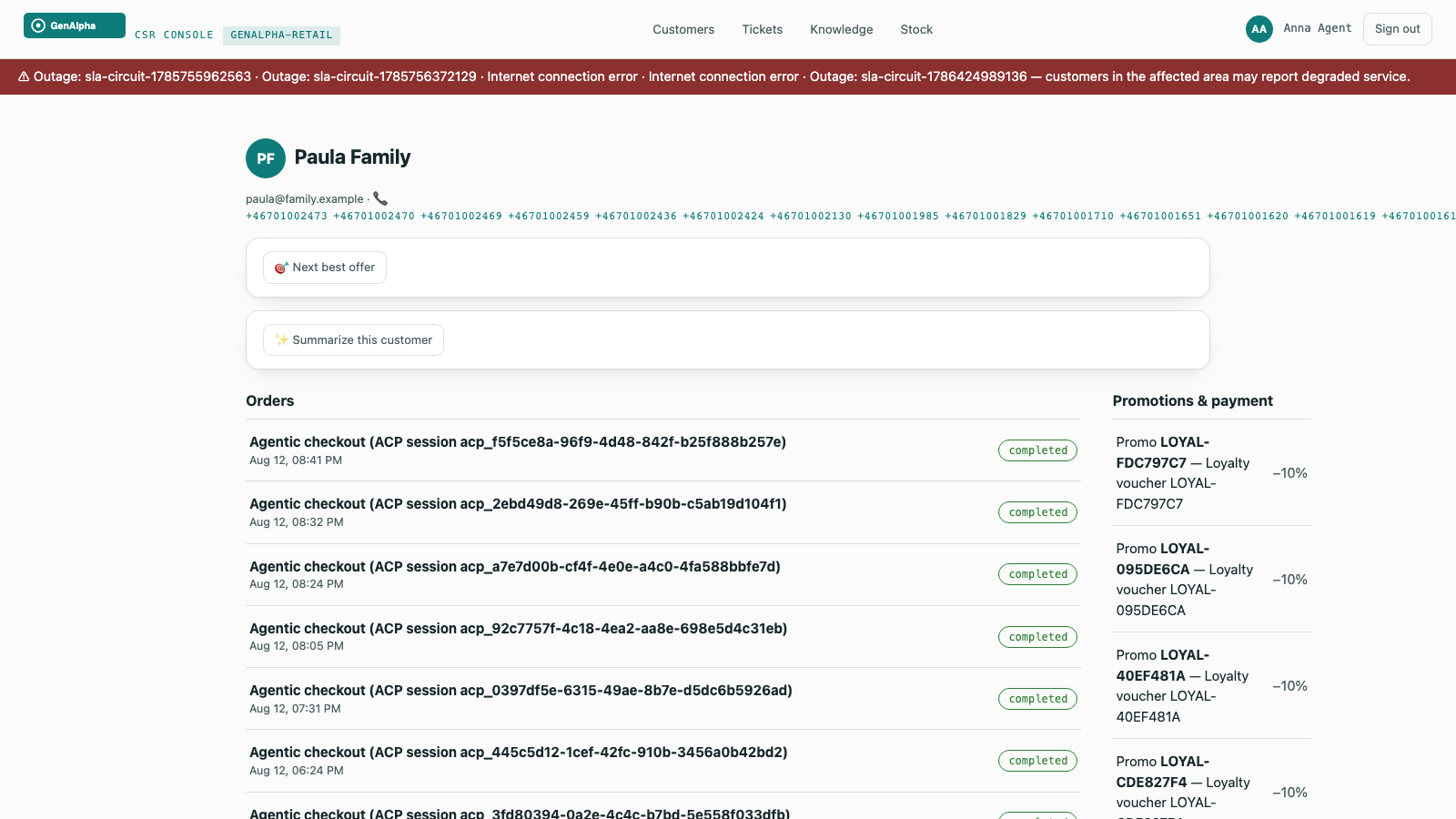
all, next best offer: the CSR presses one button, the TMF680 ranking supplies the candidates,
and the model's only job is the WHY — "they have been browsing Devices; this is the strongest
match" — grounded, sourced, never inventing an offer that is not on the shelf. The console got
an Insight ledger so the operator can SEE what the platform holds and under which consent —
read-only by design, because the visitor owns the data; the operator only gets to look.
Chapter Twenty-Eight
The growth engine, hands-on
"Why is a BSS only product and billing? Most of the data lives here. I want
to challenge the status quo." — the operator, and then the operator's whole
roadmap
This chapter is the manual the thesis earned: how a product owner actually
RUNS the marketing engine, end to end, with nothing but rows in the console. Everything below
is data — no deploys, no vendor onboarding, no CSV exports — and every step has a suite behind
it. It reads as one continuous play because that is how the engine was built to be used: the
shop pays attention, a segment forms, a campaign speaks, the readout tells the truth, and every
word said lands on the customer's record.
1 · A segment is a noticed interest
There is no segment builder, because there is nothing to build. A consented visitor who
keeps returning to the Devices category IS the Devices segment; the login stitch makes
the membership customer-grade. In the console's Insight tab the operator can see the
ledger; in Audiences, the names the tenant's own analytics computed (imported live over
the GA4 Data API's runReport wire) sit beside the first-party interests, equally
addressable. Any of those names can go straight into the next step.
2 · A campaign that can prove itself
Console → Campaigns → New: name it, put Devices in the segment field,
write the message ("{code} inserts the promo"), and — this is the part the industry
skips — set Holdout 10% and a seven-day conversion window. Execute. A deterministic
tenth of the segment is ledgered and deliberately NOT messaged; they are the control group. A
week later the detail row does not say "reached 4,000" and stop; it says treated converted
at 22%, holdout at 8%, fourteen points of lift, worth 6.10 per customer/month — the
conversion carries the catalog's own monthly price of what was actually ordered, so lift reads
in currency. Under five holdouts, the row says "an anecdote, not a measurement," because a
readout that flatters is worse than none.
3 · Two pitches, one honest verdict
Add A/B arms as a JSON field — two to four variants of {name, subject,
content} — and the treated group splits evenly and deterministically. The stats read per
arm, and the verdict is a two-proportion test that refuses flattery: under thirty people per
arm it answers "the split is an anecdote — keep the test running," and it crowns a winner only
at 95% confidence. The suite's favourite assertion: six customers, one conversion, and the
engine declining to declare victory.
4 · Journeys that read before they speak
Journeys are sequences as data: [message, wait 3 days, branch, message].
The journey-level conversion event is also the ALWAYS-ON exit rule — the customer who buys
during the wait leaves from any step and never gets "10% off!" the day after paying full price.
The branch step asks insight a question at send time — is this customer in the
Devices segment? — and speaks the matching pitch: the gadget lover hears the accessory
line, everyone else the generic one, nobody hears both. An unreachable insight fails SAFE to
the generic side, on the principle that the right-but-late message beats the wrong one.
5 · Guardrails are settings, not etiquette
The Guardrails tab holds two numbers and a window: max marketing messages per
customer per N days (campaigns skip the capped, journeys postpone an hour) and quiet
hours in tenant-local time (campaigns reach nobody inside the window — and the same
execute reaches them in the morning, skipped never lost; journeys park to the window's end).
Braze's own retrospective said teams forget optional guardrails, so here they are model, not
manners.
6 · The message leaves the building — and answers back
With DELIVERY_PROVIDER=esp a tenant's messages ALSO ride its own email
provider — SendGrid's v3 wire shape, address looked up live from party management, the in-app
inbox always the source of truth. The provider's receipts come home over its webhook: delivered
stamps the message, a bounce puts the address on the suppression list and the engine never
emails that door again — in-app continues, compliance is not optional. Segments flow outward
too: one call pushes a segment to the tenant's social platform as SHA-256 hashes (Meta's
Custom Audience schema — not one address in the clear), and the platform's lead-gen forms flow
back through the same seam into TMF699 salesLeads, idempotent on the platform's own id. Social
ad → lead → qualify → opportunity → quote → order, one system.
7 · Every word lands on the record
The oldest component in the sales story turned out to be the keystone. TMF683, the
interaction log built back in the CSR chapter, became the OMNICHANNEL record: every message the
communication component sends — a blast, a journey step, an order notification — mints a
touchpoint on the customer's timeline automatically, tagged with its source. And because the
TMF683 door is a plain open POST, anything else in the operator's landscape — the legacy CRM,
the retail till, the field-tech app — logs its calls and visits into the same timeline. The CSR
opens the 360 and reads, in one place: campaign pitch Tuesday (outbound, in-app, via
communication), order confirmation Wednesday, a phone call Thursday (inbound, via legacy-crm,
"prefers email, has 12 vans") — and speaks like someone who was paying attention. That
timeline is what "omnichannel" means when it is real: not a slogan about channels, but one
memory shared by all of them — the shop, the CSR, the campaign engine and the systems the
operator already owns, none of them asking the customer to repeat themselves.
A marketing tool proves it moved money. A sales tool remembers every
conversation. A BSS that does both, natively, is no longer missing the point of its own
data.
Chapter Twenty-Nine
The load-bearing wall
"Make it work, make it right, make it fast." — Kent Beck
Thirty-three components. Six customer surfaces, one of them wearing two faces by
role. Forty end-to-end suites, all green in a real browser. Eleven official conformance kits
passing with zero failures — and two components that fail their kits on purpose, with the reasons
written down. Business rules, prices and corporate deals that change with a row, never a redeploy.
Isolation proven against a real database — and then proven again in Norwegian, in kroner, B2C and
B2B, from one build. Plans that change without losing the number; SIMs with a PUK you can ask for;
top-ups that genuinely grow the meter; Netflix fulfilled as a partner entitlement because the
catalog category decides what a product is. A bundle composer so product owners never
touch JSON, and an order API that enforces what the composer promised. A national
number-portability flow, both directions. A quantum-safe edge and encrypted card secrets,
with the one remaining post-quantum migration parked at a seam. A network that heals itself
and leaves a receipt. And a
film — re-shot after every feature — that keeps catching real bugs, because everything on camera
is real.
Look back and the three convictions turn out to have been one conviction wearing three coats.
Vendor-neutrality — any IdP, any database, any broker, any model, any processor, any porting
authority — was possible only because every dependency was a seam, and every seam was verified with
a real implementation behind it. Honesty about mocks was survivable only because the mocks
were named and the seams were real, so the day a real Stripe or a real NRDB plugs in, nothing above
it changes. And verification was the wall that held both up.
That wall is also the answer to the question this book is really about. It was built by one
person and an AI — Claude Fable 5 — at a pace no solo human could sustain and no unverified pair
could survive. The model's breadth was extraordinary; it held the whole system in view and wired
thirty-one components without losing the thread. But breadth without an arbiter is just confident
wrongness at scale. The tests were the arbiter. Not the model's fluency, not my intuition —
a browser, a real database, an official kit, agreeing or refusing.
Give the best model the whole system to hold, and a discipline that catches it
when it's wrong, and one person can build what used to take a team — if they never stop
verifying.
That is the memoir's whole argument, and the reason its title is an instruction rather than a
boast. The future of building software isn't "the AI writes the code." It's a human holding intent
and judgment, a capable model holding execution and breadth, and a ruthless verification discipline
making the partnership trustworthy. A thirty-one-component, multi-tenant, standards-conformant BSS,
built this way, is the existence proof. Every claim in these pages has a commit, a test, or a
screenshot behind it.
Verify everything.
Chapter Twenty-Nine
What happens when the customer calls
"What if the customer wants to…" — the operator, eleven
times in a row, and every time the honest first answer was "they can't, yet"
There is a genre of question that sorts real BSSs from demos, and the operator
asked it eleven different ways in one relentless stretch. What if the customer forgets their
PIN? Loses the SIM? Wants a new number? Wants to pause the subscription for a month abroad?
Can't pay the whole bill? Wants to upgrade mid-cycle — who pays for the half-used month? Wants
a refund? Wants to leave and take the number? Wants to hand the work line to a colleague? Says
the internet is slow? Wants their daughter on the plan? Wants the bill on payday instead of the
first? None of these are features a launch demo shows. All of them are Tuesday at a call
center.
The gauntlet
Each question became the same loop: research how real operators handle it, build the
lifecycle act, notify the customer, land it on the timeline, prove it in a suite. A changed
PIN is never silent — the owner hears about it, because a silent credential change is how
fraud reads. A lost SIM quarantines the old card before minting the new one. A paused
subscription pauses charging at the OCS and comes back by itself on the promised date. A
number change quarantines the old number with its story written down. And the security
posture inverted properly along the way: self-care endpoints stopped demanding staff powers
and started demanding OWNERSHIP — any authenticated customer may act on their own line, and a
foreign line answers 404, never 403, because even "forbidden" leaks that there is something to
forbid.
Money got honest
The billing half of the gauntlet turned the engine segment-based. A mid-month start pays
from its first day, labelled "(from the 16th, 15 days)". A mid-cycle plan change bills each
plan for exactly its own days. A cease bills to the end date and no further. Underneath them
all, one invariant the suites enforce from every direction: no day is ever billed
twice — every billing run clamps its period to the day after the last covered one. On top
of the honest bill came the honest hardship path: an unpaid bill splits into installments that
sum exactly; a missed one earns one reminder, then a grace, then the broken plan lands on a
dunning worklist with the remainder due through one visible door. A disputed charge pauses
collection while a human decides, and the decision — credit or uphold — is written to the
customer in either case. Payday alignment closed the arc: pick a day, the cycle follows it,
and the bridging stub bill covers exactly the gap days, because the no-double-billing
invariant holds even across a change of rhythm.
A demo sells the happy path. An operator lives in the other eleven. The
system is only real when "what if the customer wants to—" stops being a stump and starts
being a suite number.
Chapter Thirty
The bill leaves the building, and the money comes home
"I see that bills don't open as PDF… and the format we support in Norway is
EHF, whereas I guess it's EDI in Europe. Check and make this a configurable option."
— the operator, half right, which is the useful kind of wrong
The research corrected the premise first, which is what research is for.
Europe's e-invoicing standard is not EDI: it is EN 16931, one semantic model with two
syntaxes — UBL 2.1 and UN/CEFACT CII — and Norway's EHF is a national profile of Peppol BIS
Billing 3.0 riding the UBL syntax, with one national demand that matters: a payment
reference, the KID, stamped into every invoice. EDIFACT, the operator's guess, is the
pre-XML legacy a trading partner might still demand — real, but a follow-up, not the
standard. That correction shaped everything built next.
Formats became rows
A format profile is policy, not logic: which syntax, which CustomizationID, whether a
payment reference is required. So profiles became database rows a tenant admin edits in the
console — and the suite proved the rows are load-bearing by editing one and watching the very
next e-invoice change on the wire. Australia arrived as a seeded row. Germany's XRechnung was
typed into a form. EDIFACT and Factur-X — the hybrid PDF with the machine-readable CII
embedded inside it — arrived as two more syntaxes behind the same rows, proven by flipping a
row and flipping it back. Adding a country stopped being a release and became an INSERT.
Delivery grew a ledger, and the buyer answered
Fire-and-forget was not how money documents travel, so cutting a bill began writing a
delivery ledger row in the same transaction — the outbox property: if the bill exists, the
intent to deliver it exists. A relay drains the ledger with backoff; the suite knocked the
access point over twice and watched the third attempt land, exactly once. Then the buyer's
answer joined the same row: a Peppol Invoice Response — accepted, rejected with the buyer's
words, paid — so one row tells the document's whole life. The buyer's "paid" is a claim,
though. Money is only real when the bank says so.
And the money came home
The bank says so in dialects. ISO 20022 camt.054 XML. Norway's Nets OCR giro file —
eighty-character fixed-width lines, amounts in øre, the KID right-adjusted in columns
fifty-one to seventy-five. America's BAI2 lockbox. All three land on one webhook that detects
the dialect from the first bytes, reduces it to credit entries, and matches each entry to a
bill by the payment reference the invoice carried out. A clean match books a real payment and
settles the bill through the same guarantee path a card uses — and the customer is thanked,
because a bill that closes itself silently reads as a glitch. Everything unclear — unknown
reference, wrong amount, a re-sent file — parks on the unapplied-cash worklist with its
reason. Money is fail-closed: never guessed, never dropped.
The bill is a conversation in three directions: the document out, the
buyer's answer back, the money home. A BSS that only prints the number has done a third of
the job.
Chapter Thirty-One
Selling through someone else's store
"In Norway, chains like Elkjøp and Power sell the CSP’s products." — the
operator, describing the entire physical distribution of a real MVNO in one sentence
A CSP without stores of its own makes the electronics chains its shelf. That
model has three shapes and the system grew all of them. The DEALER CONSOLE, a sixth channel,
where a clerk whose organization holds a dealer agreement sells at the counter. The STARTER
KIT, a SIM in a box with an activation code — and, decisively, the dealer attribution baked
into the kit itself, so a box sold like a chocolate bar still credits the store when the
customer self-activates on their sofa, no partner system ever involved. And the PARTNER API,
because Elkjøp and Power run their own tills: the agreement row names an OAuth2 client, the
credential IS the dealer, and a rate limiter at the edge keeps one chain's retry storm from
ever crowding out another.
Being a dealer is a row, not a role. A clerk's power is their org membership, checked
live; a foreign dealer sees 404-shaped nothing, because attribution is also isolation. And
the chains sell their OWN phones — their stock, their fiscal registers, their
kassasystemlova obligations — so the device rides the sale as context on the commission
entry, never as a billable item. The BSS is many things; a certified cash register is
deliberately not one of them.
Commission moves like money
The money-out ledger inherited the money-in discipline. Commission accrues PENDING at
activation, because Norway gives every customer fourteen days to change their mind. It
hardens to EARNED when the withdrawal window closes. And when a customer uses their
angrerett on day three, the pending entry claws back with the reason written on it — not in
an email thread, on the row. The suite runs the whole arc on dev clocks: sold, pending,
earned, and one honest clawback.
A dealer channel is attribution you can audit, money that can change its
mind, and walls between chains. Everything else is a login page.
Chapter Thirty-Two
The third operator in an afternoon
"Can our BSS host an MVNO?" — the operator, asking the
question the architecture had been quietly answering all along
Two operators on one deployment had been the proof of multitenancy. The MVNO
question exposed the asterisk: both were baked into every service's configuration as build
artifacts. A third would have meant editing thirty-one files and rebuilding the world. So the
wall came down in three moves. The tenant fleet became a FILE — one shared registry, the
union of every service's per-tenant fields, mounted everywhere; adding an operator became
appending a block. Then a script did the afternoon: clone the template realm, append the
block, restart, seed — and suite forty-nine timed it at a hundred and twenty-five seconds
from nothing to a customer whose first bill was already correctly PRORATED in her own
currency, because a newborn operator inherits honest billing for free.
Then the restart went away
Every service grew a small refresher that re-reads the shared file on a timer, and the
security resolvers — which had always built their issuer trust lazily — honored a newborn
tenant's first token with no further work. That made the operator a FORM: five fields in the
admin console — id, brand, locale, currency, color — and the running fleet grows a tenant.
Eleven seconds from a blank form to a served customer, zero restarts, zero builds. The
white-label came free, because the gateway had always served each storefront's manifest from
the registry by hostname: the moment the refresher ticked, shop.aurora.localhost wore
Aurora's name and color.
The boundary, written down — and the day it bit
Live mutation followed: change a serving operator's brand or bank token in the file and
the fleet follows within one interval. But identity — the id, the issuer, the key endpoints —
stays restart-territory, enforced in code, because the security caches key by issuer and a
boundary you can name beats one you discover. The guard on the mutation endpoint exists
because its absence bit within the hour: a failed test run renamed Nova "Hijacked" through
the unguarded door, and the refreshers loyally carried the vandalism fleet-wide — then healed
it just as fast when the file was corrected. Live mutation cuts both ways. That is why seed
operators are protected, form-born operators are form-mutable, and the incident is in this
book instead of buried.
Hosting is the multitenancy thesis with a deadline. Two operators prove
the walls; the third one, born in an afternoon and rebranded while serving, proves the
business.
Chapter Thirty-Three
The channel the law designed
"The call centers who sell subscriptions are generally outsourced partners
with their own dialling system… is our BSS catering to them too?" — the
operator, and the answer was "structurally, yes — legally, not yet"
Outbound telesales was the channel where the law wrote the architecture. A
call center is, structurally, a dealer with a phone — the same agreement row, the same
org-membership agents, the same machine credential for their dialer, the same commission
ledger — and all of that carried over untouched. What telesales ADDED was three things the
dealer channel never needed, and each one is a legal requirement wearing an API.
The wash
Norway keeps a reservation register: a citizen who says "do not call me" may not be
called, and certainly not sold to. So the wash runs FAIL-CLOSED before any offer exists — a
per-tenant seam to the register, and three refusals that each say why. A reserved number
refuses with the reason. An UNREACHABLE register refuses too, because "we couldn't check" is
not consent. And a tenant that never configured a register has no outbound channel at all:
the operator opts IN by configuring the wash, never out. The dial list inherits the same
honesty upstream — the dialer pulls its audience from the same consented segments campaigns
use, every number washed at export, and the reserved citizen is EXCLUDED AND COUNTED
("1 reserved excluded", said out loud on the agent's screen), never listed.
The offer that is not an order
Under angrerettloven, a consumer agreement made on an outbound call binds only when the
customer confirms it IN WRITING afterwards. Most systems model that as an order with a flag.
This one models it as the law reads: the call's output is an OFFER — a confirmation code, an
expiry clock, and NOTHING else. No order. No service. No commission. The letter in the
customer's inbox says the honest thing — "Nothing is ordered yet" — and the confirmation is
an AUTHENTICATED act: the signed-in customer confirms their own offer, which is a stronger
"in writing" than any bare link, and it made the security fall out for free. A stranger with
a stolen code sees a 404. A re-click orders nothing twice. Silence expires on a clock, and
the partner's pipeline shows offered, confirmed, expired — three honest states.
Identity is earned
The cold prospect closed the loop with the arc's best design decision. Someone who is not
a customer yet cannot receive an inbox letter — so the code returns to the partner, whose
dialer's own SMS is the only channel that exists for this person. And identity is EARNED,
not invented: the prospect registers with the offered email — the registration is the
identity proof — signs in, and confirms. The offer binds to them at that moment. Order,
activation, commission: the same spine as the warm base, joined at the instant the law says
an agreement started existing. Commission too is born at confirmation, not at the phone
call — because a partner paid for calls optimizes calls, and a partner paid for confirmed
agreements optimizes honesty.
Three partner channels — the retail chain, the POS integration, the
call center — on one attribution-and-commission spine, each shaped by its own regulation:
the cash-register law stays in the certified till, the withdrawal law lives in the
confirm-after-call. A channel is a set of legal facts with a UI.
Chapter Thirty-Four
Advice with receipts
"Is it possible to add some feature on the product side that recommends
enhancements… can also do market analysis and suggest new products and prices?"
— the operator, asking for the most dangerous feature in the book
Dangerous, because an AI that suggests products and prices is one careless
design away from an AI that invents them. The Product Advisor was built on the opposite
premise: it COUNTS before it speaks. The top-up attach finding is arithmetic — customers
holding both a plan and a top-up in the product inventory are the receipt that the plan's
allowance is priced below their appetite — and the finding carries its numbers ("2 of 2
customers on this plan also bought top-ups") next to a ready proposal. The market half reads
a per-tenant FEED SEAM, the same pattern as the banks and the ESPs: a mock tariff-comparison
subscription in the demo, a real market-intelligence provider in production, the same hole.
A rival meaningfully cheaper on the same data bucket becomes a finding with both prices on
it. The tenant's LLM gets exactly one job: narrate what the arithmetic found. The numbers
never come from the model.
The advisor that refused to find
The build's best moment was a failure that wasn't. The first mock rival sold ten
gigabytes at 14.50 against our 15.00 — and the advisor said NOTHING, because a three-percent
gap is inside the ten-percent materiality threshold, and an advisor that cries about noise
teaches its owner to stop reading it. The mock was sharpened to 11.90 and the finding fired
with the numbers on it. Two more receipts came out of the build: top-ups never appear as
billing rates (they are one-time — the honest source is the inventory), and TMF lists cap at
a hundred rows with the newest on the last page, so an advisor that doesn't paginate is an
advisor that can't see recent history.
And every suggestion is a PROPOSAL, never an action: adopting a finding births a draft
offering — lifecycleStatus "In study" — visible on the product owner's console, provably
absent from the shop until a human promotes it. The Copilot's governance pattern, reused:
the machine drafts, the person decides, the suite checks the draft did NOT leak into the
active catalog.
An advisor earns trust the way an accountant does: by showing the
arithmetic, by refusing to speak when the numbers are noise, and by never having the pen
that signs.
Chapter Thirty-Five
The right-sized mind
"Is it possible to use different AI models for different tasks AT THE SAME
TIME… summarizing and email writing with a cheaper model, tough tasks by a high-end model?"
— the operator, describing AI economics in one sentence
Summarizing an email and designing a product are not the same kind of
thinking, and should not cost the same. The answer took one enum and a cache key — and THAT
is the chapter's real lesson. Every AI feature in the system already spoke through one
seam, the per-tenant LLM router; no call site had ever talked to a model directly. So
"different models simultaneously" was not a rewrite: the router learned to resolve
(tenant, tier) instead of (tenant), and the fleet of features sorted itself.
The task class lives at the call site
The design decision that matters is WHERE the classification lives. Not guessed from the
prompt — declared in the code, by the developer who knows the stakes: campaign copywriting,
knowledge answers, the CSR's 360 summary and the advisor's narrative are FAST; the product
copilot's proposals and the next-best-offer judgment are SMART. Unclassified work defaults
to SMART, because "when in doubt, spend" is the only safe default for a machine that speaks
to customers and product owners. And the tiers go all the way down: not just the model but
the WHOLE PROVIDER resolves per tier — provider, endpoint, key, model, each value
tier-first, shared-second — so a local cheap endpoint can do the volume work while a
frontier API does the judgment, for the same tenant, in the same minute.
The proof is on the wire, because routing that is merely configured is routing that is
assumed. The mock LLM names the model in every answer and keeps a ledger of which API
dialect served which prompt; the suite reads copywriting answered by the cheap model over
the OpenAI dialect and the copilot by the frontier model over the Anthropic dialect —
one tenant, two providers, two models, at once — while the tierless tenant on the stub is
untouched, because tiering is per-tenant data, not a global rewire.
The seam discipline paid its dividend here: a feature that sounds like
an architecture project — "multiple AI providers per tenant per task" — cost an enum,
because for two years nothing was ever allowed to call a model directly.
Chapter Thirty-Six
Three homes for the bytes
"Before going ahead with S3, I also want to know if this will run on
Azure." — the operator, asking the question that saved the design
The product media had always lived in the honest-but-humble place: a BYTEA
column in Postgres, with a comment in the migration admitting the ceiling. But when the
object-storage work was finally scheduled, the codebase had a surprise waiting — past-us had
already built the seam. A ContentStore interface, an in-row default, and a
comment predicting this exact chapter: "pointing an operator's S3 at the same API is one
adapter class." The architectural decision had been made months earlier; only the adapters
were missing. That is what a seam discipline buys: future features arrive as fillings, not
surgeries.
The question that shaped the build
The operator's gating question — will it run on Azure? — turned a one-adapter task into
the right two-adapter design, because the honest answer was NO, not automatically. AWS,
MinIO, Cloudflare R2 and Google's interop mode all speak the S3 protocol; Azure Blob speaks
its own dialect, SharedKey signatures and all, and the once-standard gateway shims are
discontinued. A BSS whose front page says "vendor-neutral" and whose Terraform ships an AKS
stack cannot treat Azure as an S3 pretender. So the seam grew two thin adapters — the whole
SigV4 ceremony and the whole SharedKey ceremony, each in ~150 lines of plain HTTP, no SDKs —
and the storage choice became one environment variable. The build's one bug was a spec
detail worth keeping: against Azurite, Microsoft's own emulator, the canonicalized resource
carries the account name TWICE — path-style addressing puts it in the URL, the signing rules
demand it again in front — by the spec, not by accident.
The standard agreed all along
TM Forum, it turns out, had blessed the move before it was made. The Attachment pattern
that runs through every TMF API is url-OR-inline by design — an attachment is canonically a
reference to content that lives elsewhere, with inline bytes as the convenience case. And
TMF667 is a document MANAGEMENT api: metadata, categories, lifecycle, over content whose
physical home was always meant to be someone else's problem. Fronting Postgres BYTEA was the
unusual arrangement; fronting an object store is the typical one. The suite proved it the
house way: the same upload-and-serve loop against all three stores, with the DATABASE giving
the receipt each time — in-row shows the bytes in the row; the cloud stores show content IS
NULL beside an s3: or azure: key. The bytes provably moved; the API and every attachment URL
never changed by a byte.
"Any cloud" was a claim on the README for months. Now it is a database
row that says NULL where the bytes used to be — in two dialects.
Chapter Thirty-Seven
The rungs before the ladder
"When to upgrade search with Elastic?" — the operator,
asking the question whose best answer is a date far in the future
Some upgrades are won by refusing them. The search question had an obvious
expensive answer — an OpenSearch cluster, RAM-hungry, operated forever — and a boring
correct one: Postgres has rungs, and the system had climbed none of them. So the decision
became a framework instead of a purchase. Elastic earns its place when someone asks for the
OMNIBOX — one field searching parties, tickets, orders and articles together, ranked — or
when search traffic deserves its own scaling axis. Until then, the rungs: and when that day
does come, the event backbone is already the indexing pipeline, because every party, ticket
and article publishes to Kafka — the hard part of an Elastic adoption, built years early for
other reasons.
A net that only speaks when strict is silent
The first rung was the typo net. The CSR search — multi-word, term-AND, name-ranked, the
shape a real bug report once forged — stayed byte-identical BY CONSTRUCTION: trigram
similarity only runs when the strict search returns nothing. A query that finds people
answers exactly as yesterday; "solvieg fjelheim", two misspellings deep, now finds Solveig
instead of an empty list. And it fails open — on a database without the extension, the empty
answer simply stands. The upgrade's safety was not tested into it; it was designed into the
control flow, and then tested anyway: the suite proves the four behaviors, and seven
regression suites — including the dealer and telesales channels, which look customers up
through the same path — prove nothing else moved.
Each tenant searches in its own tongue
The second rung fixed a bug that had been invisible in English. The knowledge base's
full-text search was hardcoded to the English stemmer — so nova's Norwegian articles were
being stemmed by rules for the wrong language, wrong by construction, unnoticed because the
demos searched in English. The tenant's locale now picks the stemmer, with an index per
language: "regning" finds "regningene" and "regninger", which no amount of English
morphology could do. Multitenancy turned out to reach all the way down into linguistics —
the registry field that picks the storefront's currency now also picks how words break.
Meaning finds what words cannot
The third rung came days later, and kept the family shape: a net that only speaks when
the layer above is silent. pgvector put an embedding beside every article — a vector column
the JPA entity never maps, so the unit tests never knew — and when full-text finds nothing,
cosine neighbours answer under a strict ceiling. The suite's proof pair says everything:
"why is my internet so slow" finds the fair-use article that contains NEITHER word, because
throttling and slowness are neighbours in meaning-space — and "purple elephant orchestra"
finds nothing at all, because a net that invents relevance teaches its readers to ignore it.
The embeddings themselves are a seam, of course: a deterministic keyless stub (hashed words
folded through a curated telecom synonym table, English and Norwegian both) for CI and
air-gapped demos, any OpenAI-compatible model when an operator wants learned semantics.
Three nets now stand in a row — trigram under strict, stemmer per tongue, meaning under
keywords — each honest about when it speaks, and honest about when it stays silent.
Cost of the three rungs: one image tag, two trusted extensions, four
indexes, zero new containers. Cost of the road not taken: a cluster, forever. The best
architecture decisions are sometimes the ones that end with Postgres doing one more thing.
Chapter Thirty-Eight
The boring engineering
"Do you think our BSS is production ready? Can it scale, does it have
redundancy and failover — is it secured?" — the operator, asking the only
question that matters after fifty-five suites
The honest answer was uncomfortable and useful: the architecture was right
and the operations were not. Fifty-five suites proved the system CORRECT; none of them
proved it SURVIVABLE. And the first thing that would have failed in production was not
exotic — it was arithmetic. Nine scheduled ticks move money and send mail: dunning notices,
paper bills to the print house, campaign sends, commission hardening. Run any of those
services twice — the very first thing a Kubernetes deployment does — and every tick fires
twice. Two dunning letters. Two paper bills. The feature that makes a system scalable is,
embarrassingly often, the feature that stops it doing everything twice.
The lock is a row
The fix kept the house style: no coordinator, no new dependency. A tick_lock
table in each service's own database and seventy lines that play the ShedLock algorithm
straight — claim a lease with an atomic UPDATE-then-INSERT, release when done, expire on
crash so a dead replica never wedges the fleet. The claim runs in its own transaction, so a
lost race can never poison the tick's real work. And the proof was the receiver's, not the
sender's: the suite raised a SECOND billing replica against the same database — two
schedulers racing every three seconds — cut a bill, and asked the mock print house how many
copies it held. One. The twenty-seven outbox relays were left deliberately unguarded, and
the reason is the point: at-least-once delivery with dedup at every consumer was designed in
from the first event, so a duplicate relay is waste, never harm. Where the contract already
absorbs duplication you leave it alone; where it moves money, you lock the row.
A ceiling on every door, and a backup that is not a hope
The dealer surface had rate limits because partners get retry storms; every other door
was unmetered. Now the gateway runs two rings — the strict per-partner buckets it always
had, and a wide generous ceiling on everything else, counted per person, per machine, per
address, so one caller's flood never becomes everyone's outage. And the backup learned the
book's oldest lesson: nothing exists until a suite has seen it. backup.sh dumps
the fleet; restore-drill.sh restores it into a THROWAWAY container and goes
looking for a sentinel customer created minutes earlier. The suite found her in the copy.
An untested backup is a hope. This one is a fact with a timestamp.
What remains is written down where claims go to be audited —
docs/hardening.md: managed HA databases, TLS inside the cluster, load tests, the compliance
ledger. Production-ready is not a feeling; it is a list, with the unticked boxes showing.
Chapter Thirty-Nine
The run that survives its own death
"go ahead with P1 hardening" — the operator, four words,
the morning after P0 shipped
The billing run had a secret it shared with most young systems: it was one
transaction. Every customer's bill, one commit, all or nothing — which reads as integrity
until you do the arithmetic. At a thousand customers it is a long transaction; at a million
it is a transaction that never commits, and one bad account rolls back everyone's bill at
minute fifty-nine. The fix inverted the shape: the GATHER phase reads, then each account's
bill commits alone. And the resume logic cost nothing, because it already existed — the
idempotency check that stopped double-billing a customer within a period became, unchanged,
the checkpoint of a crashed run.
The suite's FIRST run failed — and the failure was the best find of the arc. The ledger
showed what no code review had: a thousand and seventeen accounts accumulated by months of
suite runs, a paced pass that outlived the client's patience, and the retry loop quietly
starting a SECOND run while the first one's orphaned thread kept walking — two runs racing
the same period, saved from double-billing by timing alone. Luck is not a guarantee, so two
fixes followed the diagnosis: the run now takes the same row-lease the ticks take — a second
trigger gets an honest busy, and the lease HEARTBEATS per account so a crashed run
frees it in two minutes, not a run-length — and the database itself gained a unique index:
one bill per account per period, as a constraint rather than a convention. Then the suite
passed the way it was meant to: twelve customers, a kill mid-flight, a resume to exactly
twelve bills, a ledger showing one run superseded beside one completed.
The run has a face now; even its deaths are rows.
The ceiling that outlives its gateway
P0's rate limits had a caveat written beside them the day they shipped: the buckets lived
in memory, so N gateways meant N× the ceiling and every restart was an amnesty. P1 moved the
buckets behind a seam — in-memory for a laptop, Redis when replicas must agree — and the
proof was a resurrection: trip the ceiling, kill the gateway, and the FRESH process refused
the very first knock. A window that survives its enforcer is a window replicas can share.
Numbers, at last — with their caveats stapled on
Fifty-six suites had proven the system correct and none had ever timed it. A plain-Node
load driver fixed that in an afternoon: on one laptop carrying all thirty JVMs, catalog
browse answered six hundred and seventy-eight times a second at thirty-nine milliseconds
p95; authenticated bill reads — every request paying the full JWT-plus-row-level-security
toll — four hundred and fifty-one. Floor numbers, the baselines document says plainly, not
capacity claims; their job is to make regressions loud, and the suite's smoke SLO stands
tripwire duty at ten times the baseline. The load test's first victim, satisfyingly, was
the wide ring itself — the harness got throttled by P0's ceiling and had to ask for it to
be lifted. The guardrails guard even the auditors.
And alerts exist now — ServiceDown, a stalled outbox, a 5xx front door,
evaluated over thirty-two scrape targets where five had been. A dashboard nobody watches is
documentation; an alert is a promise that silence means something.
Chapter Forty
The right to be forgotten, with receipts
"go ahead with P2 hardening" — the operator, and the last
unticked boxes were the ones the law owns
A European subscriber holds rights the way they hold a phone number: legally,
specifically, and with someone obliged to answer. The right of access got the build's most
satisfying privilege design: the data passport rides the CALLER'S OWN TOKEN. When a customer
exports themselves, party-account walks every service that holds a piece of them —
interactions, messages, marketing touches, carts, tickets, appointments, behavioural
profiles — presenting the customer's own credentials at each door. Every service returns
exactly what that token could already read, which means the right of access required no new
authority anywhere: it is what the person could always see, finally gathered into one
portable document. The DPO — the user-administrator wearing a second hat, honestly
documented — may name another party. Nobody else can, and the refusal is a 404, never
a 403.
Erasure that knows the law both ways
The eraser refuses twice, and both refusals are the feature. A subscriber with an ACTIVE
plan cannot be erased — 409, terminate first, because erasure never breaks a running
contract; and the check FAILS CLOSED, refusing when it cannot prove the inventory empty
rather than guessing. And the bookkeeping categories — bills, payments, orders, usage,
agreements — are retained with their legal basis NAMED in the report, because a tax
authority's five-year claim on an invoice outranks a deletion request, and pretending
otherwise would be theatre. What the law does not hold, goes: seven services delete their
slices, the profile anonymizes IN PLACE — "Erased", no contact media, the id surviving as
the pseudonymous peg the retained records hang on — and the login dies at the identity
provider, name and email scrubbed from the realm. The report of all of it becomes an
immutable audit row. The suite's favourite assertion is the quietest: after erasure, the
person's own password simply stops working.
Clocks, card numbers, and honest boundaries
Retention became a clock — interaction records and settled tickets deleted on schedule
by the same guarded ticks that stopped double-firing in P0; open tickets are never touched,
and the dev default is "keep forever" so no suite loses its timeline. The PCI question got
the verify-then-claim treatment: the payment vault's columns are token, brand, last-four,
expiry — no card number has anywhere to live — an SAQ-A-shaped posture claimed only as far
as a README may claim it, a QSA attesting the rest. And lawful intercept was answered the
NRDB way: shaped, not connected — the BSS half is warrant-gated disclosure, and it ships
when an operator with a legal obligation names its national format.
Fifty-eight suites. The last one proves a person can leave — completely,
audibly, and with the paperwork the law demands on BOTH sides of the deletion. A system that
can forget you on purpose is a system that was honest about remembering you.
Chapter Forty-One
One laptop, two worlds
"go ahead with the live k8s soak" — the operator, naming
the oldest unticked box in the backlog
The Helm chart had been template-verified since the day it shipped and never
once run, because one laptop cannot carry fifty-five compose containers and a Kubernetes
cluster at the same time. So the two worlds traded places: compose stopped, and k3s — parked
inside the same VM, deliberately stopped since a crashlooping leftover had starved it —
started factory-fresh. The dreaded step never happened: this k3s shares Docker's own runtime,
so every image the fleet had ever built was already visible, and the import script died
unwritten. The setup found three drifts no template render could have caught — the chart's
postgres lacked the pgvector the knowledge service now migrates against, both realm files had
drifted from the source of truth, and the prepared core-commerce scoping had quietly excluded
product-stock, which ordering turns out to REQUIRE: the first live order came back 502 and
taught the values file a fact. That is what a soak is FOR.
Twenty-one pods came Ready the Kubernetes way — no depends_on, just crash-until-postgres-
answers, twice each, then stable. The smoke proved requests, not readiness: a token from the
in-cluster Keycloak, an offering authored THROUGH the gateway into the cluster's own
database, an order accepted. And the receipt the whole exercise existed for: billing ran as
TWO replicas — the per-service dial added that morning — and the tick_lock table showed both
ticks leased by a single replica id. The locks built in P0 for a scale-out that was then
hypothetical held on the first real one. Ten minutes of soak, zero new restarts; then the
worlds traded back, compose resumed, and a regression confirmed the demo fleet never noticed
it had been away.
The chart is no longer a promise with a lint pass. It has run — small,
honest, and observed — and the three things it got wrong are now three things it says.
And then, the real cloud — the same afternoon
Hours later the bigger sibling ran on actual AWS: a fresh account, a ten-dollar budget
alarm armed before anything billable existed, Terraform raising a VPC, an EKS cluster and an
RDS Postgres in Frankfurt. The first live cloud run caught three more truths at about a
dollar each: the EKS module's newest major quietly stopped granting its creator access to
the cluster it builds; ARCHITECTURE is part of the image contract — Apple-Silicon images are
arm64, and the stack's x86 nodes refused every one of them until Graviton nodes (cheaper,
natively arm64) replaced them; and the pinned Kubernetes version had aged into extended
support at six times the control-plane price. Then twenty-two pods came Ready, the smoke
passed against a managed database, the tick locks held their one-speaker rule inside RDS,
and the operator browsed their own storefront — served from a cloud region, added a plan to
a cart, and found the scope's edge as an honest 500 where the cart service wasn't deployed.
One helm flag later it was. Ten minutes, zero new restarts. "Any cloud" now has its first
receipt with a real invoice behind it.
The second cloud, and what it argued about
Azure came a few hours later, on Founders Hub credits, and where AWS had taught three
truths at a dollar each, Azure argued about nearly everything — which is its own kind of
proof. A brand-new subscription refused western Europe outright ("not accepting new
customers"); the Nordic region it accepted had no Kubernetes capacity; the region that
finally took the cluster offered a VM catalog gated TWICE — by what sizes existed and,
separately, by a per-family quota that could read zero for a size sitting right there in the
list. The sponsorship tier offered no ARM chips at all, so the morning's Graviton lesson
inverted: the images had to be rebuilt for x86 and cross-pushed under emulation. The managed
database demanded TLS the fleet didn't speak, refused to create extensions until they were
named in an allow-list, and capped its connections low enough that thirteen services'
pools drained it dry — which taught the chart to hold fewer idle connections, a fix that
makes it kinder to every managed database, not just this one. Terraform's own half-applied
state left orphans to import by hand, more than once.
And then — past all of it — the same twenty-three pods came Ready in Ireland, the same
smoke passed, the same two billing replicas held their one-speaker lease inside a database
called Flexible Server instead of RDS, and the operator opened the same storefront, this
time served from Microsoft's cloud. Not one line of application code had changed between the
two runs; every single difference had lived in Terraform and two Helm flags. That is the
whole argument for vendor-neutrality, made twice in one day, in two companies' invoices. The
seams held. "Any cloud" is no longer a sentence in a README — it is a Tuesday.
Chapter Forty-Two
The governed machine
"does it make sense to have a control plane that authenticates, budgets and
audits all LLMs, tools and agent calls?" — the operator, asking the
question every AI-native product will eventually be asked in a procurement meeting
The honest inventory said two-thirds yes: the intelligence service already
authenticated every AI call, held the keys, routed per tenant and per tier, redacted PII and
kept a ledger. What it could not answer was the procurement meeting's second question — what
does it COST, and what stops it? — and its third: when the AI *does* something rather than
says something, where is that written? So the router became a governor. One door: kill-switch,
then budget, then the model, then the meter, then the ledger. Every turn now carries its
token count and its cost in micros; a tenant's spend sums against a ceiling an operator sets,
and the ceiling refuses FAIL-CLOSED — the same law the rate limiter and the do-not-call wash
already obeyed, applied to the newest metered resource. The kill-switch turns a tenant's AI
off in one flip. And agent actions — the advisor adopting a draft into the catalog — land on
the same ledger as the conversations, naming the resource they touched.
The suite's second failure taught the arc its best lesson. The budget refusal worked —
the 429 arrived — but the refusal's own audit row had vanished: the governor wrote the
evidence and then threw, and the caller's rolling-back transaction erased the record of why
it rolled back. A refusal that erases its own evidence is not governance; it is amnesia with
good intentions. The fix was the billing run's lesson reapplied — ledger rows commit in
their own transactions, because the ledger records what HAPPENED, regardless of what the
caller's transaction later decides. Three failures had now taught the same principle in
three costumes: the audit outlives the erased, the superseded run keeps its verdict, and
the refusal keeps its receipt.
Fifty-nine suites. The AI was always authenticated; now it is metered,
budgeted, killable and accountable — per tenant, behind the same RLS wall as the money.
When the EU AI Act auditor asks "show me every automated decision and what it cost," the
answer is a table, not a meeting.
Chapter Forty-Three
A shelf of one's own
"good morning, lets do the personalization arc" — the
operator, naming an arc the ledger said was already delivered
The first honest act of the morning was archaeology: the personalization arc
had shipped eight days earlier — consent spine, guest experience rules, the analytics seam,
segments, A/B arms with an honest verdict — and the plan's own status line read "nothing
named remains." So the question became what personalization OWES a customer next, and the
answer was individuality: not a segment's page, but a shelf of one's own. The signed-in
customer's "For you" rail generalizes the CSR desk's next-best-offer from
one-offer-for-the-agent to a rail-for-me — and it is SELF-scoped by construction: the party
is the token's own subject, there is no parameter to probe, so the endpoint cannot show
anyone a shop that is not theirs.
The assembly is receipts-before-advice, as always: the TMF680 ranking — already fused
with consented interests by the earlier arc — IS the arithmetic; an open churn-risk alert
adds a loyalty flag, because the offer that keeps a customer is personalization too; and
the model's only job is one warm sentence, grounded in the customer's own trail and nothing
else. That sentence rides yesterday's governed door — metered, budgeted, kill-switchable —
and a five-minute cache means a browsing session costs one model call, not one per page
view. The suite's favourite pair of assertions: Alice, who consented and browsed devices,
reads "picked for you after your look at devices" over her rail — and Bob, who declined,
gets a rail with zero interests and a caption that borrows nothing. Personalization as a
reward for consent, never a default.
And because a shelf of one's own should travel, the rail follows the customer onto the
mobile app the same afternoon — the same caption over the same picks in the pocket edition,
served from the same five-minute cache, so the second channel costs zero extra model calls.
One governed rail, every channel.
Rules you can say out loud
The day's third movement closed the authoring loop: the product owner TELLS the copilot
what device-browsing guests should see — "show them the banner, pin the 60 GB plan" — and
the proposal card shows an EXPERIENCE RULE beside the specs and prices the copilot already
knew how to shape. One click, and it is a policy row in the personalization domain, created
with the owner's own token because the model never writes; the next consenting guest who
browses devices is greeted by the chatted banner over the chatted pin, and the rule can be
disabled in Rules like any other data. The suite's arc is the product's whole thesis in
miniature: conversation → validation → data → a different page for the right person — and
then deleted as data, leaving the defaults exactly where they were. Authoring as
conversation; personalization as policy; nothing as code.
The last look wins
And the fourth movement closed the CDP loop the field calls "next-hit": what you look at
on one page changes the very next. The signal was already in the event stream — every
offering view, timestamped — it was simply being read by FREQUENCY (your all-time
favourite) when the moment wanted RECENCY (the thing you just looked at). One window and one
ordering flipped it: the session's most-recent category now leads the next page, and the
offerings you just viewed come back as a "pick up where you left off" rail, freshest first.
The suite's crisp proof is a reversal — a guest looks at phones twice and a plan once, and
the next page leads with the PLAN, because the last look wins over the many. None of it
exists for the guest who declined, and none of it crosses the tenant wall. Personalization
that reacts in the moment — and still asks first.
Sixty suites. The shop now knows the difference between "people like
you" and YOU — and it learned it the only honest way: by asking first, spending inside a
budget, and writing every word it generates into a ledger someone can audit.
Chapter Forty-Four
What goes with this
"there is also one feature missing in webshop related to recommendation…
like customer who bought this also likes this… like iphone will likely buy iphonecover"
— the operator, naming the oldest trick in retail
Every shop on earth answers one question at the shelf: what goes with this?
The webshop could already rank a shelf FOR a person — the "For you" rail — but it could not
yet speak for the crowd: customers who bought this phone also bought that case. The data was
never missing. The recommendation component already read the tenant's whole inventory to
rank popularity; the same rows, grouped differently, ARE the market basket. Group every
owned product by its owner, and each customer becomes a basket; for any offering, tally what
else its owners hold, and the tally is the answer — no model, no training run, just honest
counting over what the tenant's customers actually own together.
Two design choices carried the honesty. The first is a minimum support of two: an
offering appears in the rail only when at least two of the anchor's owners also hold it —
signal over noise, and a privacy floor, because a rail that reflects a single customer's
basket is a window into that basket. Aggregate or absent, never in between. The second is
that the endpoint is PUBLIC, like the product page it decorates — a guest with no token
reads it, because it reveals only what the crowd did, never who the crowd is. And it is
tenant-walled like everything else: nova's shoppers see nova's baskets, reached by nova's
hostname, because the gateway stamps tenancy from the host and a spoofed header dies at the
door.
The build's best gift was the bug it flushed out. The affinity rail came up EMPTY against
a tenant whose customers demonstrably co-owned half the catalog — because the inventory
client fetched one page of five hundred products and the tenant had two thousand two hundred
and eleven. The fix — walk every page — repaired affinity AND quietly sharpened the
popularity ranker that had been sampling the same truncated sample all along. One bug, two
features honester. The suite learned its own lesson the same day: proving a minimum-support
floor against REAL data means seeding baskets on offering ids unique to the run, because two
thousand real products co-own their way into any shared id you borrow.
Sixty-three suites. The demo tenant's own data supplied the closing
argument: buyers of the Samsung flagship also take the home bundle — a hundred and
fifty-seven times. The shop did not guess that. It counted.
Chapter Forty-Five
A door for the agents
"so our mcp server still dosent expose core commerce… which means anyone
trying to purchase using perplexity or chatgpt etc wont be able to see our offerings?"
— the operator, finding the missing door
The question was sharper than it looked. The MCP server had been the proof
of the B2B slice story — intent, feasibility, quote, order — and in the glow of that demo it
was easy to believe the BSS was "agent-ready." It was not. Not one retail offering was
visible to an AI agent. A customer who asked their assistant to find a phone plan would be
told, truthfully, that this operator does not exist. And the research said the gap was wider
than a missing tool: shopping agents do not browse arbitrary MCP servers. ChatGPT's checkout
speaks the Agentic Commerce Protocol — an open standard: a product feed, a checkout-session
lifecycle, a delegated payment token. MCP reaches Claude's kind; ACP reaches the storefront
inside ChatGPT. Honesty demanded both, so the build shipped one core wearing two
transports: the ACP surface IS the agent API, and the MCP tools are a thin skin over it.
Nothing new was invented underneath — that is the point of a spine. The feed is a
projection of the TMF620 catalog, priced by the storefront's own rules; an offering the feed
cannot price honestly is skipped, not guessed. A checkout session IS a TMF663 cart wearing
protocol dressing, so agent baskets sit in the same funnel and the same abandonment
analytics as human ones. And complete is a payment and a TMF622 order created with the
CALLER'S token — the cart service forwards the credential it was handed and never lends its
own, so an under-authorized agent is refused by the same services that refuse any
under-authorized human.
The one genuine design decision was authority. An agent buying FOR a customer must hold
less than the customer — not a machine identity, which holds more. The answer was OAuth
token exchange: the shopper's credential goes in, and what comes out is scoped to a
confidential client that has been granted exactly five authorities — read the catalog,
order, pay. The realm must name the delegation path explicitly (an audience mapper on the
shopper's client; without it the exchange is refused), and the suite does not take the
downscoping on faith: it DECODES both tokens. The customer's carries twenty-five
authorities — bills, profile, tickets. The agent's carries five. Same subject, less power,
provable by anyone with a base64 decoder. Money got the same discipline: a replayed
Idempotency-Key returns the SAME order, and a fresh key against a completed session is
refused — one approval, one purchase, ever.
And then the operator's question behind the question: who decides to be shopped by
machines? Not the platform, and not the default. A per-tenant switch — off, discovery,
full — lives in the same registry file as every other tenant capability, enforced at the
gateway, live-refreshed, flippable from the operator form. Off is a 404, because a closed
door should not confirm there is a room behind it. Discovery is the honest middle every
retailer will ask for: be findable, be comparable, keep the checkout human. And every
NEWBORN tenant is born off — being bought from by AI agents is a choice an operator makes,
never one it discovers. The demo fleet proves all three positions at once: one tenant sells
to agents, one shows itself and declines to sell, one does not exist.
Sixty-four suites. The last assertion is the quiet one: paula's own
token reads the order the agent placed for her, channel-marked and tenant-walled — because
a shop that lets machines buy must first let humans see what the machines bought.
Chapter Forty-Six
The hired hand
"can hermes agent type agent be part of the suite to do backoffice,
callcenter, customercare etc work?" — the operator, opening a
position
Agents that buy from you were chapter forty-five. Agents that work FOR you
turned out to need a different noun entirely: not a channel, an EMPLOYEE. And the moment
you say employee, every hard question answers itself, because a century of employment has
already answered it. Who decides they work here? The employer — so the badge (a
digital-worker role on the same TMF672 surface every human grant uses) is the opt-in, and
revoking it is the firing. What may they touch? What the badge says — the grant itself
sheds the walk-in customer defaults every login is born with, because a worker
party-scoped like a customer would be confined to an empty world of its own. And who
watches? The scoreboard, which in this shop is not an afterthought: it is the product.
The job is a queue that refuses to lie. Open tasks are DERIVED, live, from the backlogs
that already exist — unassigned tickets, unapplied bank payments — never copied into a
second list that can go stale. A claim is a lease, so a crashed worker's task frees
itself; and completion is VERIFIED where verification is cheap: a ticket task completes
only when the ticket is actually resolved, a cash task only when the payment has actually
left the worklist. The suite's favourite refusal is the 409 that meets a worker announcing
"done" over work that is not done. Escalation, meanwhile, costs nothing and carries a
reason — counted, never punished — because an agent that escalates honestly beats one
that resolves wrongly, every single shift.
Money and endings stay human. A refund, a cease, an erasure — the worker may PROPOSE,
as data: a method, a path, a body, and the one sentence a human will decide on. Nothing
executes. When a human clicks Approve on the Workforce tab, the stored action runs under
THE HUMAN'S own token — the domain services judge the approver exactly as they judge
anyone — and a refusal keeps its receipt beside the approvals. Filing is the worker's
authority; deciding is staff's; the suite proves a worker cannot approve its own ask. The
same afternoon, that gate flushed out a real bug nobody had met: refunding a payment that
had no customer attached crashed on its own receipt — back-office refunds worked here for
the first time because a machine tried to propose one.
And the scoreboard tells the truth at its own expense. Completed, escalated, deflection,
handle time — and the REOPEN RATE, the number a vendor would hide: tickets the worker
closed that are open again, re-checked live against the source. "Human-minutes saved"
carries estimate: true in the payload and shows the operator-set baselines it was
multiplied from, because an estimate that says so can sit next to numbers that do not have
to. Even cost is labeled: the worker brings its own model, so its spend is its own
self-reported word, never dressed up as the control plane's metered truth. Hermes — the
open-source agent daemon the package documents end to end — is the reference employee, not
a dependency: the job, the badge and the audit speak MCP and OIDC, and any runtime that
speaks them can be hired. The shop now employs machines the way it does everything else:
provably, revocably, and with the receipts on the wall.
Sixty-five suites. The dashboard's last assertion is the arc in one
gesture: a human reads what the machine did all day, clicks once on the thing the machine
was never allowed to do — and the click is the write.
Chapter Forty-Seven
The loop closes
"since we are shipping hermes agent as an additional package with bss,
hermes agent can be fully created and controlled by bss" — the operator,
refusing a copy-paste step
The workforce's one manual seam was the clipboard: hire a worker, copy its
credentials, paste them into a runtime's config. The operator called it out — if the runtime
ships WITH the BSS, the loop can close — and he was right, with two boundaries kept. The
package now BUILDS the headless worker image Nous doesn't ship, and a small
worker-controller — deployed only by the opt-in profile, the sole holder of spawn-rights the
core BSS deliberately never has — makes hire a running container with the badge injected
(credentials touch no human) and fire a revoke-and-stop. The worker's BRAIN became live
registry config on the operator's second demand: change the model or the key in one file and
the controller ROLLS the workers onto it — free, because claims are self-expiring leases; a
restarted worker abandons nothing. Suite sixty-six proved it all first run, including the
live brain swap. The dashboard's Hire button now produces an employee that is already
working — and the first worker it hired resolved two tickets and honestly escalated a
storm-damaged router to field diagnosis.
Sixty-six suites. One click hires a working, badged, revocable AI
employee — and the click is still the operator's.
Chapter Forty-Eight
On top of what you already have
"many companies already have several bss running… can this bss run on top
of other bss as top layer?" — the operator, naming the go-to-market
Nobody rips out a running BSS. The insight arrived as strategy and left,
the same day, as proof. First the positioning had to be corrected — the operator caught it:
lead with the whole BSS, sell the entry point, or a complete catalog-to-cash suite gets
filed as a wrapper. Then the receipt: a deliberately old-shaped mock legacy stack —
envelope JSON, PROD_CD keys, a work-order queue — wrapped through three per-tenant seams,
the same pattern that already carries the PIM, the ESP, the PSP and the bank. A legacy BSS
is just another seam.
Suite sixty-seven proved all four legs on its first run: the legacy catalog FEDERATED
into the agentic feed, priced and legacy-prefixed; an agent BOUGHT a legacy offering
through the standard delegated checkout; the order HANDED OFF into the legacy queue —
genalpha keeps the engagement record, legacy keeps fulfilment, never two writers; and the
digital workforce worked the legacy incident backlog, age-stamped, with the deepest
guarantee intact across the wrap: completing the task while the LEGACY system said OPEN
met a 409. "A worker cannot mark done what is not done" now holds even when done lives in
someone else's decades-old stack.
Sixty-seven suites. Your only BSS — or the layer on top of the ones
you have. Both, now, with receipts.
Chapter Forty-Nine
The face the crawlers see
"what about GEO vs SEO stuff… is it something we should have in our bss?"
— the operator, completing the funnel
The agentic funnel had a transaction half — agents could BUY — but discovery
belonged to a different kind of machine: the answer engines, recommending an operator when a
human asks their assistant for the best plan in Norway. The research pass earned its keep by
what it refused to believe. The industry's favourite artifact, llms.txt, turned out to be
mostly theater — ten percent of sites publish it, and across half a billion analysed
LLM-bot events the fetches were statistically negligible. The finding that actually
mattered was plainer: AI crawlers do not execute JavaScript. The storefront — a React SPA,
chosen deliberately so one model ran web, iOS and Android — was invisible to the machines
now deciding what to recommend.
The fix honoured the choice instead of reversing it. No rewrite, no second page to
maintain: the same shop URL now DUAL-SERVES by a gateway User-Agent predicate. A crawler
gets complete HTML with schema.org Product and Offer markup, rendered live from the TMF620
catalog; a human gets the untouched app. Nothing is authored twice because nothing is
authored at all — both faces read the same source of truth, and the suite refuses to trust
that: it asserts, on every run, that the bot page's price EQUALS the catalog's. Faces
proven equal, never maintained equal.
And the operator keeps the choice, at the lever crawlers actually obey. The
ai-visibility switch — open, search-only, dark — executes at robots.txt, with the middle
state the field will actually want: classic search yes, AI answer and training bots no.
Three tenants prove the three positions by hostname; newborn operators are born
conservative. llms.txt ships for open tenants because it costs nothing — labeled in the
docs as exactly what the data says it is, a speculative courtesy — and never sold as the
feature. The funnel closed: engines that recommend you, agents that buy from you, workers
that work for you, on whatever estate you already run.
Sixty-eight suites. GPTBot and a customer ask for the same page and
each gets the truth in the shape they can read — which is all a face was ever for.
Chapter Fifty
The map that admits its gaps
"partner dealer agreement — is that a business capability or tech
capability? …just asking" — the operator, keeping the machine
honest
The document a buying architect asks for first is not the demo — it is the
map: which business capabilities does this cover, through which functions, in which
component, and what must I still bring from elsewhere? The map was drawn in the house
style: a suite number on every check mark, a partial mark that carries its caveat out loud
— the PSP that defaults to mock, the OCS facade that is not a charger, the clearinghouse
shaped but not connected — and a gaps column that names, without flinching, what a real
operator still needs from other systems: a production charger, a taxation engine, the
ledger, roaming settlement, fraud, loyalty, trucks. Then the closing move that turns
honesty into a pitch: every named gap sits behind an existing seam or the overlay pattern,
so the list reads as an integration plan, not a wall. A map that admits ten gaps out loud
is believed on its sixty-eight check marks.
And then the operator did what the operator does. "Partner dealer agreements — business
capability or tech capability? Just asking." He was right: the map had let ODA functional
blocks wear the business-capability hat — "product catalog" is a system function; the
business capability is define and manage sellable offers — and had promoted an
eTOM domain to a capability. Forty-six rows were rephrased verb-first and
implementation-free, and the map now opens by defining the three levels it uses, so the
next reader cannot make the conflation its author did. The machine wrote the map; the
human kept its categories honest. That division of labour is, by this chapter, the whole
book.
The map then grew its second face: an executive view — colour-coded dots, one-click
filters, the verdict row first (forty-four proven, three partial, nine gaps) — and the
red-chip filter turned out to be the most persuasive screen in the product, because it is
the one no vendor ever shows. It is GENERATED from the architect's table by a small script,
so the two faces cannot drift: one source of truth, many faces, equality by construction —
the same discipline as the crawler pages and the agent feed, applied to a sales document.
Sixty-eight suites, and one table that tells a buyer where they end —
which is the only kind of table a buyer trusts about where they begin.
Chapter Fifty-One
The currency of staying
"i see reward and retain customers (loyalty) is a big gap in market sales
and channels… research and plan what we can build in our bss for that" —
the operator, reading his own map
The map did its job within a day of being drawn: the operator looked at
his own red chips and picked the reddest one in Market & Sales. Loyalty. The research
pass came back with a finding that reshaped the build before it started: a telco loyalty
program is not a points catalog with toasters in it. The most-loved reward in this industry
is DATA — zero marginal cost, instantly deliverable, churn-relevant — tier benefits are
mostly pricing, and earning follows the billing relationship, not shopping trips. Which
meant this BSS already owned the three hardest parts. It had an allowance-boost mechanic
that could put gigabytes on this month's meter. It had a promotion engine that could mint
voucher codes. It had a policy engine that priced by rules-as-data. Loyalty was mostly a
LEDGER, plus wiring between engines that existed.
So component thirty-four became TMF658 the house way: the program is DATA a marketer
edits — earn rate, gigabyte price, tier thresholds, expiry clock — membership is opt-in
at the storefront, consent-style, never automatic, and every movement of points is an
append-only journal row that carries its cause: this bill, this redemption, this expiry
sweep, this goodwill adjustment with its REQUIRED reason, because goodwill has a cause
too. A settled bill earns at the program's rate, idempotent per bill. And the suite's
discipline held at the burn: when paula traded a hundred points for a gigabyte, the
assertion did not read the loyalty API's own word for it — it read the usage meter, and
the meter had risen. When points minted a voucher, the code was a REAL promotion, valid
at the same door WELCOME10 uses, redeemed once and refused the second time. When the tier
computed gold, the benefit was ONE console-authored pricing rule — the pricing engine
needed no new code at all.
The honest hard part was never the features. Points are a LIABILITY — an operator owes
its customers whatever the balances sum to — so the governance shipped as first-class API:
an expiry sweep, fleet-safe under the tick guard, that journals every point it takes; a
liability endpoint whose number a finance team can book; and a suite leg that proved the
sweep honest by watching young points SURVIVE a one-month clock rather than rigging a
pass. Then retention closed its loop with no new machinery: the tier-change event rode
the outbox into the martech ear, and a campaign — one console recipe — landed a real
message in paula's inbox. The churn scorer's alert can now answer with a currency:
your points are waiting.
Sixty-nine suites. The map's reddest row went green the only way
this book allows — earn proven on the bill, burn proven at the meter, and the debt to
the customer carried as a number finance can read.
Chapter Fifty-Two
The honest subledger
"dosent bss need to send GL info to ERP and other system?"
— the operator, asking the finance question
Two questions arrived together, and they were both really about scope. Does
the BSS owe the general ledger a feed? Do we need PCI-DSS if the payment gateway is
external? The second had the shorter answer: an external PSP reduces scope, never removes
the obligation — and this schema earns the lightest tier honestly, because the vault holds
brand, last four, expiry, token, and there is no card-number column anywhere for an auditor
to find. The claim writes itself the way the PQC one did: not certified — that is the
merchant's yearly ritual — but PAN-free by construction, receipts in the repo.
The first question deserved research before code, and the research came back with a
settled industry shape: the billing system is the SUBLEDGER; the ERP's ledger receives
summarized daily journal batches against control accounts; the mapping from business events
to debits and credits is data, not code. Which is this house's whole doctrine wearing a
green eyeshade. So component thirty-five became the subledger: a double-entry journal where
BALANCE IS A SAVE-TIME INVARIANT — an unbalanced entry refuses to exist, rather than
surfacing in a report three weeks later — and a chart of accounts that finance renames at
will, because every booked line SNAPSHOTS the code and name it was born with. Remapping
changes the future; history is not editable. An accountant would call that obvious. Most
software does not.
The recon earned its keep twice. It caught that a matched bank payment fires TWO events
— the remittance and the recorded payment — so cash books once, at capture, whichever door
the money came through. And the build's best failure was an invisible privilege: the admin
API hands every new service account the realm's default roles, which include CUSTOMER — so
billing politely confined the machine to "its own" bills and 404'd everyone else's. A
machine identity holds exactly the roles it needs, and nothing it merely inherits.
The suite ties the knot the way finance would: paula's fifty-euro bill becomes one
balanced entry whose AR debit equals the bill to the cent; replaying it creates nothing;
a refund books the reverse of its cash; and the reconciliation carries the loyalty points
liability as a labeled control number that must MATCH the loyalty component's own — two
systems agreeing about a debt neither is allowed to value in currency, because a point has
no exchange rate until the program prices one. The ledger stays in the ERP, where it
belongs. What leaves here is the feed it always needed.
Seventy suites. The map's oldest red row now reads the only way a
finance system should: we are not your ledger — we are the subledger your ledger can
finally trust.
Chapter Fifty-Three
The paper that says sorry
"i guess we already completed functionality for credit note both in bss
and frontend for billing" — the operator, remembering a feature that
did not exist
The operator was sure credit notes were already built. The grep said no —
and that correction, delivered before a line of code, is the whole method in miniature:
the machine's first job is to keep the record honest, even about itself. What existed was
the adjacent machinery — dispute credits that quietly shrank a bill, refunds that moved
money back — but no DOCUMENT. And bookkeeping law is about documents: the wrong invoice
is never edited; a kreditnota with its own number, in an unbroken series, referencing
what it reverses, says so out loud.
The unbroken series turned out to be the interesting part. Thirty-five components in,
billing had never needed a sequential counter — every number in the fleet is UUID-derived,
because UUIDs never collide and never coordinate. A GAPLESS sequence is the opposite kind
of number: it must coordinate, under a row lock, inside the issuing transaction, because
an auditor reading CN-000007 next to CN-000009 will ask where CN-000008 went. The suite
proves the series the only way that matters — two consecutive issues, two consecutive
numbers, on camera.
Then the flows folded in instead of multiplying. A credit on an unpaid bill brings
the due down and the document says why; a credit on a settled bill moves real money back
through the PSP; a dispute resolved with a credit now mints its own paper, so every
goodwill gesture has a number an accountant can hold. The subledger books the reduced
kind under the document's own number and refuses to double-book the refunded kind — one
path, never two — and the regression that broke was the good kind of break: the journal's
tie-out had to LEARN that a bill's booked gross minus its credit notes equals its live
due, which is not a test accommodation. It is the accounting identity the feature exists
to maintain.
Seventy-one suites. The customer holds a PDF that says sorry with a
number on it — and the ledger, the bill, and the apology now agree to the cent.
Chapter Fifty-Four
Closing the books
"go ahead with revenue phase 2 … go ahead with credit note P2 … go ahead
with revenue P3" — the operator, finishing what the map started
The finance movement finished the way it began: every new power arrived as
DATA on a posting key, never as code. A VAT percent on the tax key split every posting
into net revenue and a tax-payable credit — with the tax computed as gross minus the sum
of the nets, so rounding CANNOT unbalance an entry; the arithmetic forbids it. A
per-point value on the liability key turned the loyalty control number into a real daily
accrual that books only the delta against the loyalty component's live figure — and
unpriced points stay a control number, because the machine does not invent valuations.
And the period close made the export FINAL: a posting aimed into a closed period refuses
with a 409, reopening is an explicit act, and finality — an accountant will tell you —
is the entire point of closing.
The credit note grew into its legal clothes. The kreditnota now renders as UBL
CreditNote-2 — type code 381, the EHF and Peppol BIS shape — carrying the one element
the law is really about, a BillingReference naming the invoice it reverses, and it ships
on the SAME distribution ledger as the bills, same relay, same retries. Credits learned
to name their target: a note can reverse one rate line specifically, the negative line
carries that line's own name, and a line cannot be over-credited. The dispute worklist
landed in the back-office console rather than the CSR console the plan first named —
a deviation recorded, not hidden — because that is where the deciding privilege actually
lives. Agents open disputes; admins decide money.
Then revenue's last phase drew the cleanest line in the whole movement. The rev-rec
export hands the ERP one row per active commitment — who, what, from when, for how many
months, how far along — and REFUSES to restate prices, because the journal already says
what was billed and this file says what was promised; allocating one across the other is
the rev-rec engine's job, and pretending otherwise would make the BSS a second source of
accounting truth. And the deferred-revenue checkbox got the best answer of all: an
analysis instead of an entry. A top-up's gigabytes land on the current month's meter the
moment the order completes — the obligation is satisfied inside the period, so there is
nothing to defer, so nothing was booked, and the plan says exactly why. The machine's
proudest posting is the one it declined to make.
Seventy-one suites, thirteen kits at zero. The books close the way
books should: balanced by invariant, final by decision, and empty of every number nobody
could defend.
Chapter Fifty-Five
The fourth failure
"have we thought about tmf701 to do process orchestration and IG1547 for
context management ai native operation?" — the operator, bringing a
next question
The question deserved a first answer more honest than enthusiasm. The
industry's oldest operations tax is well documented: every engineering organisation
runs some form of on-call rotation, a developer at reduced capacity diagnosing the
same recurring failures from scratch, because the knowledge never compounds — and the
agent demos of the moment, stateless by construction, do not change that arithmetic.
This fleet, it turned out, had the same disease in a purer form. Thirty-six components of well-behaved choreography,
and NO failure state anywhere in the order path — a stuck order was a silent wait, and
the one component that knew the cross-system timeline kept it deliberately ephemeral.
Choreography, it turns out, is superb at running flows and mute when asked to explain
one.
So the fix came in the only defensible order: visibility first, intelligence second,
memory third. TMF701 gave the flows an explaining face — design intent as editable
specs, instances projected from events the fleet already published, and STUCK promoted
from a grep to a state that speaks on the bus. Only then did the agent get to listen: a
failed task triggers context assembly — what was owed, what arrived, in what order,
through which systems — and a diagnosis that walks through the same kill-switch,
budget, meter and audit doors as every other model call. Its only write is a ticket
note signed by the machine. Everything else is memory: a trace per investigation, and
a HUMAN VERDICT that is mandatory, because a lesson nobody confirmed is not a lesson.
The third movement is the one the whole arc exists for. Three confirmed traces on
one signature drafted a runbook; a human approved it; and the FOURTH identical failure
was diagnosed from procedural memory — no model call, the audit count standing still
as the witness, the hypothesis carrying its runbook version like a citation. The suite
asserts the learning curve as a number, which is the entire difference between an agent
that is impressive and one that is improving. And because remembered mistakes compound
too, the brake got equal billing: revoke the runbook and the next failure goes humbly
back to the model, under governance, to earn its lesson again.
Seventy-two suites. The on-call rotation's tragedy was never the
hours — it was the amnesia. This fleet now diagnoses its fourth recurrence from memory,
and can prove on demand that it learned, what it learned from, and who signed off on
the lesson.
Chapter Fifty-Six
The faces the fleet had earned
"which tmf are left now, like this process one we identified?"
— the operator, reading the map again
The TMF701 arc had proven a method: find the flow the fleet already runs,
give it its standard face, and let the gaps it exposes become visible work. The operator's
next question applied the method as a sweep — what else had the fleet earned but never
claimed? The audit came back with six, in value order, and the first one was embarrassing
in the best way: physical fulfilment, the process layer had just revealed, was a silent
wait ended by a CSR clicking "Complete". No shipment, no visit, no tracking — a button as
load-bearing infrastructure.
So the parcel and the visit became resources. A physical order mints a shipping order
the warehouse drives over its own API; an install booking mints a work order; and only
when the parcel is DELIVERED and the visit COMPLETED does the order complete,
machine-driven, race-safe against the button it demoted. The suite proved the gates the
honest way — a delivered parcel alone did NOT close an order with an open visit — and
caught a real wall hole en route: customers hold ordering rights for their own orders, so
only an explicit party-scope refusal keeps them out of the warehouse. Then the SLA arc
made promises pay: terms as agreement data — the circuit, the minutes, the pre-agreed
credit, the monthly cap — and a breach mints a violation on a capped ledger and a credit
note nobody approves at breach time, because the contract approved it at signature. Three
outages, two credits, a third recorded-but-capped, on camera.
The event hub gave the event-native fleet its standard subscription — register a
callback and a filter, receive the same envelopes the components exchange, with a
delivery ledger that retries the missing and keeps the error on the dead. And the last
three faces cost almost nothing because the substance already existed: the incident
agent's memory became TMF724 incidents whose state machine is the verdict discipline
itself; the diagnose triage became TMF653 tests with history, same code path, same owner
check; the number plan became TMF639 — a generator pool honestly refusing to invent an
"available" count, because the face of a thing must never claim more than the thing
knows.
Seventy-six suites, thirty-eight components, six new standard faces
in one sweep — and not one of them built new substance. They named what the fleet had
already earned, which is what standards are for.
Chapter Fifty-Seven
The configurator that was hiding in the browser
"any other tmf left?" — the operator, unwilling to
leave a standard on the table
The last gap on the list was hiding in plain sight, which is where the
best ones hide. The storefront's Offering page WAS a product configurator — choice
groups, pick-one-of-three radios, colour and storage pickers, a price that followed
every selection — and every rule that made it one lived in client JavaScript. TMF760
is the standard face for exactly that machine, and the recon found something better
than a gap: it found three half-enforcements that nobody had ever added up. The
storefront checked only the LOWER pick bound, trusting radio-button physics to hold
the upper. Ordering checked both bounds, but only at submit time. And nobody, anywhere,
validated a characteristic VALUE — a nonsense colour rode through every channel
politely.
So the configurator moved server-side, onto the catalog that already owned every
input, as two stateless task resources — no task table, nothing persisted, the POST
computes and answers. The query returns the configuration space as data: the groups,
the bounds, the defaults, the pickers, and every conditioned price with its condition
visible. The check runs all three validations no single channel had, speaks ordering's
exact error language so a configure-time refusal reads like the order-time 400 it
prevents, consults policy under the catalog's first machine identity, and prices the
pick with the storefront's own matching semantics ported verbatim — Titanium Edition
two euros dearer than Icy Blue, on its own line, only when that exact string is
picked on the phone that has it. Anonymous, deliberately: configuring IS browsing.
Then the second phase collected the proof the arc was really for. The agent channel
— the one selling over MCP and ACP — could only say "id and quantity", so the suite's
first leg bought the family bundle flat and watched ordering's cardinality gate refuse
it. The gap, on camera. Then the same bundle went through configured: the check's
answer now carries an ORDER-READY echo, each selected option holding exactly the picks
its own spec owns, so the cart turned it into nested order items without understanding
specs at all — and the same gate that refused the flat purchase accepted the
configured one. The premium landed on the Samsung's line, where billing would rate it,
the same as if a human had clicked it.
Seventy-eight suites. One rule, one place, every channel: the
storefront validates for speed, but the configurator decides — and an AI agent can now
sell what yesterday it could only misconfigure.
Chapter Fifty-Eight
Never a bare no
"also then do the next tmf" — the operator, keeping
the sweep moving
The next question moved from the catalog to the address, and the recon
came back with a distinction worth the whole arc. The fleet already answered the
COMMERCIAL question — may this offering be sold here? — with postcode gates the
storefront consulted at every checkout. But nobody answered the TECHNICAL one: what
can the network actually deliver at this address, at what speed, over what? An address
was "serviceable" or it wasn't, a one-bit answer to a question every telco shopper asks
in full sentences. TMF645 is the standard face for the full answer, and the honest way
to build it was NOT to re-serve the commercial rows under a technical path — a face
must never claim more than the thing knows. The arc needed new substance: the
operator's footprint as data.
So the coverage map became rows an operator edits: fiber at a gigabit in
Stockholm's inner city, half that in Göteborg, three hundred in Malmö beside the
hundred-megabit copper that remains, and 5G fixed-wireless everywhere via an empty
prefix — the fallback that matches when nothing else does. On top of it, the two
TMF645 verbs: query answers "what can I get here?" per place, longest prefix winning;
and check carries the behavior the standard exists for — it never says a bare no.
Fiber where there is none answers no WITH the best technology the address can have,
proposed as an alternative. A bandwidth ask above the plant's ceiling is refused
naming the ceiling. And every check persists, readable back by its unguessable id,
because a qualification is a fact a channel may need to show again — while the list
of checks stays back-office, because other people's addresses are nobody's shop
window.
The second phase gave the answer teeth and a voice. Teeth: the ordering API had
never checked serviceability at all — the storefront's discipline was client-side,
so an API-direct or agent order for un-serviceable fiber sailed through and died at
fulfilment, days later, as a parcel with nowhere to go. Now every placed item is
qualified at create, at the one door every channel walks through, and the refusal
speaks the qualification's own words. One design call mattered: the gate rides the
COMMERCIAL check, because an order names an offering and a place — inventing an
offering-to-technology mapping the data does not carry would have been the same
dishonesty the arc began by refusing. And the voice: the cart's address block now
says not just whether but what — "Fiber up to 1000 Mbit/s at your address," or, where
the fiber ends, "5G broadband up to 100 Mbit/s" — the footprint speaking directly to
the person about to sign.
Eighty suites. The commercial question and the technical one now
have separate, honest answers from the same small service — and the refusal that used
to arrive as a failed delivery arrives as a sentence, with an alternative attached.
Chapter Fifty-Nine
The scalpel beside the kill-switch
"update the books with the 915 arc and then start another tmf"
— the operator, in the rhythm now
Of everything the fleet had built, the strangest omission was this: its
most differentiated machinery had no standard face. Every model call in the system
walks through one door — kill-switch, budget, meter, one audit row, refusals included —
and that door had been suite-proven for months. TM Forum's TMF915 asks exactly the
question this machinery answers: how does an operator GOVERN AI deployed at scale? Its
central idea, the model contract, mapped onto the fleet's eleven scenario identifiers
almost word for word. And the honest rule held again: a face may only claim what the
thing knows. So the models the face lists are the ones the audit ledger PROVES have
served — a stub, two local llamas, a real frontier model from past experiments, and
the one genuinely versioned artifact, the trained churn classifier with its training
record. Nothing registered. Everything observed.
The face's first breath told months of truth at once: sixteen contracts projected
from the ledger, campaign-copy alone carrying sixty-eight calls, its spend in micros,
its average latency — and every refusal class, including the refused-budget and
refused-disabled rows an old suite had left behind like fossils. That is what an audit
ledger is FOR: the face didn't need to be told the history, it inherited it. But the
recon had also found the one honest gap worth new substance. The only brake was the
tenant-wide kill-switch — all the AI or none of it. TMF915's in-life contract
management is precisely the missing lever, so the arc built it: a per-scenario switch,
checked in the governor's gate order, refusing with its own audited outcome. The suite
suspended campaign-copy over the standard face, watched the next call refuse ON the
ledger, and watched a different scenario keep answering. One scenario braked; the
fleet unharmed.
The arc also opened a door that had been promised in a comment since the control
plane was born: the governance controller's javadoc had always said a production
deployment would separate an ai:admin authority — "the seam is the matcher." Contract
suspension and budget-setting now require it, and the suite proves the split the only
honest way: a staff user holding ai:use alone, refused on camera. And the regressions
taught their own lesson — the day's Keycloak recreate had silently reverted a
live-set token lifespan, killing long suites mid-wait, and the fix went where every
such fix now goes: into the FILES first, then live. The file-plus-live doctrine, it
turns out, covers realm settings too.
Eighty-one suites. The machine that governs the machines is now
itself governable over a standard — models it can prove, contracts with their real
numbers, refusals with receipts, and a scalpel where there used to be only a
kill-switch.
Chapter Sixty
The other direction of trust
"go ahead with the plan and build" — the operator,
five arcs into one day
The fleet had spent months learning to score who might LEAVE — the
churn scorer, its features, its alerts. It had never once asked the opposite
question: who should not be let IN? Subscription fraud is acquisition's oldest tax,
and TMF696 is its standard face. But the recon mattered more than the spec here,
because its most important findings were about what the data could NOT say. Failed
payments leave no row — a refused charge throws and persists nothing, so "how many
failed payments has this party had" is unanswerable, and the face must not pretend
otherwise. And nothing anywhere records that a party has EVER BankID-verified —
verification lives in the session token and dies with it. Two silences, both honored:
the engine scores neither.
What it does score, it scores in the open. Unpaid bills, credit notes, order
velocity, account tenure, the order's own bulk — each signal contributes named
points and carries its raw evidence inside the assessment body, so the total
recomputes by hand from what the assessment itself says. The first real run argued
the design better than any demo script could have: kai, the storefront's oldest
test customer, scored eighty-five — two genuinely unpaid bills, seventeen genuine
credit notes, and forty-six orders in twenty-four hours of genuine suite traffic.
The suite fetched every number independently and watched them match. And the
verified session became the great reducer: the same order, BankID-verified, scored
exactly twenty lower — the strongest anti-fraud signal the fleet has, known only to
the token that carries it.
Enforcement went where this fleet keeps all its decisions: in data. Ordering
fetches a fresh assessment under its own machine identity and drops two variables
into the policy context; the OPERATOR's rule decides the threshold. The suite pinned
a ceiling just under kai's score, watched his order refuse with the review message,
deleted the rule, and watched the same order pass — a fraud posture switched on and
off without a deploy. And one wall mattered more than the rest: a customer cannot
read his own risk score. A risk score is a credit check — the back office's honest
opinion, not a customer surface — and the suite proves the refusal on camera.
Eighty-two suites. Trust now has both directions: the fleet
knows who might leave, knows who to doubt at the door — and can show its arithmetic
for either, signal by signal, with the silences labeled as carefully as the
numbers.
Chapter Sixty-One
Partners typed, places named
"i am going to sleep, can you implement all other TMF as discussed after
this so i can check tomorrow" — the operator, handing over the night
shift
The gap list ended the way long lists end: not with a bang but with two
small, honest arcs run while the operator slept. TMF668 first. The fleet was FULL of
partners — dealers as commission rows, bill-distribution partners on the Peppol wire,
event-hub subscribers — and had no vocabulary for any of them. Worse, the recon found
that agreements accepted any role string anyone invented; "smuggler" would have signed
as happily as "dealer". So partnership KINDS became data — a kind is the roles it
permits, and a kind without roles is refused at authoring — and typed partnerships are
validated at signature, the bad role refused naming the permitted list. The restraint
mattered as much as the rule: an untyped commercial agreement signs exactly as before.
No ceremony where none is due.
Then TMF674, the address book nobody had. Addresses were flat unnamed rows; places
rode orders per-transaction and were retyped every time; the B2B org model — which
resolves membership live and trusts nothing from the request — had no way to say "the
Göteborg branch." A site is the first reusable named place: a name, an owner, a real
lifecycle, and a STORED address it must prove exists, embedded on every read. The suite
told the story end to end: the HQ address, typed exactly once when the site was born,
rode an order and landed intact on fulfilment's parcel. Entered once, reused forever.
And the night shift earned its keep one more way: the guest regression failed, and
the failure was REAL — a latent bug from the service-qualification arc three days of
work back, where the cart's new footprint line had borrowed the serviceability line's
CSS classes, so a strict locator resolved to two elements whenever one fetch won a race
against the other. The kind of bug that passes twice and fails on the third Tuesday.
It got its own class, and the flake became deterministic in both directions. That is
what the regression discipline is FOR — not to prove the new code works, but to catch
what the old code was quietly wrong about.
Eighty-four suites, and the TMF gap list is closed. Every standard
the fleet had earned now has its face; every face claims exactly what the data knows;
and the last two arcs shipped while the person who asked for them was asleep — which
may be the most honest benchmark this machine has ever passed.
Chapter Sixty-Two
The proof run
"yes do the proof run" — the operator, calling the
bluff on the project's own headline
The claim had been on the README for months: every feature verified by
a suite, all of them green. But the claim had never been tested AS ONE FACT — the
suites ran arc by arc, each against a fleet freshly warmed for it. So one morning the
whole list ran serially, one command, and the first honest number came back:
thirty of eighty-four. What followed was two days of the best engineering the project
had ever forced, because almost nothing that failed was what it seemed. The virtual
machine sat at forty-seven megabytes of headroom with no swap, and a kernel OOM killer
was quietly shooting JVMs — Keycloak first (its wrapper exits zero, so Docker never
files a report), then the Docker daemon itself, mass-restarting forty containers
mid-sweep. The closed-loop surge controller — a feature, working exactly as designed —
was hiring workers against suite-generated backlog and eating the queues other suites
were asserting on. Four stray billing replicas from failed hardening legs had idled
for seventeen hours, competing for leases and tripping rate buckets.
Under the noise sat the real finding, and it deserved its name: THE FLEET GREW
OLD. Three weeks of suite-life had left 1,304 billing accounts, 340 agreements,
duplicate console rows, a reused mock incident number — and code written for a young
fleet. The billing run walked every account serially at three to six machine calls
each: twenty-eight to a hundred and eight minutes, a third of it pure sleep from a
pacing knob nobody knew was baked into the container. A fixed limit=200 client
silently dropped newly signed SLA promises — a REAL bug, the kind that ships and
bites an operator in month three, caught here because the sweep made the fleet's age
visible. The cures compounded: the account loop moved onto a worker pool whose safety
the two-replica suite had proven long ago; a pruning runbook retired 2,685 detritus
subscriptions and made the fleet young again; and then the loveliest failure of the
whole saga — the young fleet was suddenly TOO FAST, out-running its own rate
limiter, because the old slowness had been the pacing all along. Storefront: twelve
minutes to fifteen seconds. Billing: a hundred minutes to three.
The last mile was pure discipline. A dead theory (the persona "identity split")
killed by evidence in one query. A tab click landing on a stale node during a
re-render, caught by instrumentation that printed what the page actually showed. A
suite matcher pinned to an incident number the mock had rightly stopped reusing. And
the finish: the revenue suite, five legs deep in one aged persona's ambiguous
history, cured at the root by minting itself a purpose-made fresh customer — probing
the past replaced by owning the present. Eighty-four of eighty-four, every attempt
on the record, and the receipt page says so in a table anyone can read.
The proof run found two product bugs, three infrastructure
failure layers, a dozen suite assumptions, and one law worth framing: a test fleet
ages like a production fleet, and then it heals faster than its guardrails expect.
The claim on the README is finally a fact — and the command that makes it a fact
again tomorrow ships in ops/.
Chapter Sixty-Three
The shop that knows you
"go ahead with the personalization arc, research and plan first"
— the operator, back to features at last
The oldest note in the backlog said "personalize pages and offers,"
and half of it had quietly shipped months ago — segments, campaigns, the guest
banner, the for-you rail. The recon's job was to find what the vision still owed,
and the answer was almost embarrassing: the shop never once used the customer's OWN
data to shape an offer. The meter sat one page away — the Services page drew it
beautifully — and the Shop page never looked. A visitor's full interest profile
rode the experience payload and the grid used exactly one category of it. And no
rule an operator could write knew whether a guest had ever been here before.
The flagship was the upsell, and its best part was discovering that the upgrade
ladder already existed — nobody had ever assembled it. Every offering's usage
allowance had been data since the usage arc; sorted by size within a usage type,
those rows ARE the ladder, and "the next bigger plan" is just the next rung. So the
for-you payload grew an upsell block with hard rules: only when a meter crosses
eighty percent, only the NEXT rung — the suite verifies against the ladder itself
that no smaller step was skipped — and only a real offering, linked, never an
invented deal. A customer at ninety-two percent of ten gigabytes was shown the
thirty; a customer at twenty percent was shown nothing at all, and the suite
asserts the nothing as firmly as the something. The returning guest became a
variable: `visits`, distinct days on the ledger, so "welcome back" is a rule an
operator authors as data. And the grid finally ranks by the whole consented
profile, in browse-weight order.
One decision mattered as much as any feature: pricing on the grid stayed OUT.
The experience machinery could technically bend prices per visitor, and the plan
says plainly why it never will — price is the bill's truth, not a personalization
lever. Personal means the shop reads what you already shared with it; it does not
mean the shop charges you differently for having shared it. The regression run
added its own footnote to the fleet's honesty file: two orphaned rules from
killed suite runs were quietly shadowing every guest's default experience —
cleanup code in a finally block only runs if the run survives to reach it.
Eighty-six suites. The backlog's oldest wish is closed both
halves now — marketing that measures itself, and a shop that uses what it already
knew: the meter, the profile, the return visit. Personal, honest, and never a
nag.
Chapter Sixty-Four
The night of the kits
"run ctk kit for all, use whole night to make all of them pass…
is that a right approach"
— the operator, before going to bed
Thirteen kits had agreed, and for months that number had been good
enough. But the fleet had grown since — a whole standards program of new faces —
and one evening the operator asked the obvious question: why not all of them, and
why not tonight? The honest answer required a correction first. "All of them" was
not ours to promise; every kit in this book's history had turned into its own
small war (TMF683 demanded a derived trio on every historical row; TMF654 grew a
persisted task resource), and some kits might demand architecture we had
deliberately refused. So the plan became: every kit, in priority order, each to
zero or to an honestly documented no — and the first discovery of the night
redrew the map entirely. The standards body publishes forty-seven kits. Crossed
against the faces this fleet serves, minus the thirteen already green and the two
that fail on purpose, exactly twelve remained — and for the newest faces,
the ones we had been most nervous about (events, risk, the configurator, AI
management), no kit exists at all. The mountain had a summit after all.
The first three kits were the modern generation, and they went down the way
good tools fail: informatively. TMF674 passed the moment its example payload
respected our own rule — a site's place must reference a stored address, so the
operator example simply had to store one first. But the run also caught the
harness itself lying: invoked with a relative path, the runner's newman died in
silence and the summary read a stale result file from an earlier attempt
— green numbers from a run that never happened. The fix was one line; the lesson
was old and durable: distrust the receipt printer too. TMF639 made the resource
facade grow an honest store for gear the pools never issued, and TMF642 taught
the alarm face manners nobody had ever demanded of it — real field selection,
quoted filter values, and a subtle one: the POST echo printed nanoseconds while
Postgres stores microseconds, so a timestamp a client captured could never be
used as a filter again. Truncate at the source; what the store keeps is what the
echo says.
Then came the older generation — R18-era kits, raw Postman collections from a
world before the v4 renames — and with them the night's recurring argument:
what happens when the standard's letter meets a protection we chose on purpose?
The partnership-type kit posted a kind with no roles and expected success; our
face refused, because a kind IS the roles it permits. The resolution became the
campaign's doctrine: protections move, they don't vanish. A roleless
kind now stores as valid catalog data that permits nothing — and the refusal
happens where it always mattered, at the agreement's signature, where the first
typed partnership against the empty kind dies with the permitted list quoted at
it. The suite got sharper, not looser. The same shape repeated on the service
test face: the kit posts tests against services that don't exist, our face runs
a REAL diagnosis behind every test. Staff referencing an unknown service now get
an honest inconclusive — "nothing was measured" — while a scoped
customer probing a foreign service still gets the same 404 the owner check
always gave. And where the spec demanded facts we had simply never required —
an agreement's type, a ticket's type — the fleet adopted the requirement
everywhere at once: the storefront files "support," the self-heal loop files
"incident," and the lenient defaults that had let callers omit the fact turned
out to be OUR deviation, not the standard's.
The service-inventory kit was the night's TMF683 at scale. It walks every row
of the list and dereferences the first element of six arrays on each — every
service must name a relationship, a supporting service, a supporting resource, a
party, a place, a spec. The fleet's two thousand services had none of that shape,
and the honest fill became a small essay in derivation: category read from the
name, the operator itself as a related party of every service it runs, the
service order as the provisioning record where no resource was ever issued, the
spec references pointed at a tiny new read-only catalog face so they actually
dereference — and where a service truly relates to nothing, the entry SAYS so,
an explicit standalone self-reference instead of a phantom dependency. Two probe
services had to be seeded because the kit assumes a sandbox where names are
unique and one state returns one row; the prep is documented next to the runner,
the same way the stored-address trick is. Twelve hours earlier any of this would
have sounded like weeks.
The last two kits spoke v3 outright — serviceQualification where
v4 says checkServiceQualification — and earned the campaign's most
satisfying pattern: the dialect face. A small controller accepts the old task
document, stores it, and delegates the actual evaluation to the same coverage
engine the v4 check uses. One truth, two dialects; the kit's fictional specs
came back unqualified with a real alternative proposed from the
real coverage map, because the engine genuinely ran. Items it cannot evaluate
carry a note that nothing was measured and no verdict is claimed. Along the way
the gateway gained something it had silently lacked for its whole life: a
trusted-proxies setting, without which the newer Spring Cloud Gateway never adds
the forwarded-host headers — which meant every Location header the fleet had
ever returned was a bare path, and the kits were the first client rude enough
to check it against the URL they actually called.
By morning the regression sweep had run — twelve suites over every touched
service, all green, one suite made honest on the way (the workforce ceiling
proof had been quietly leaning on ambient backlog; it seeds both of its own
seats now). The scorecard closed at twenty-five kits, zero failures, and under
it a sentence no earlier version of the page could carry: this is the
closed list. Nothing left to run — not because the night ran out, but
because the standards body has nothing further to ask of these faces.
Twenty-five kits, zero failures, two refusals explained,
and a closed list. The kits audit the whole history, so the whole history is
conformant; the facts we don't have say so out loud; and every protection that
moved is still standing — one door further in, where it always belonged.
Chapter Sixty-Five
The window they already own
"i want that any headless cms can be used if they are not using
our default bss dam"
— the operator, sketching the next seam
The device photos had just become real — actual glass and aluminium
where tinted vector shapes had stood in — when the operator asked the question that
turns a feature into a seam. What if the operator running this BSS already keeps a
content system? A Sanity project, a Strapi install, a room of marketing people who
live in a CMS all day. Were they meant to abandon it and upload into ours? The
built-in document store had always been honest about being a seam — bytes in-row
for dev, S3 or Azure Blob behind the same TMF667 surface for the cloud — but every
one of those still kept the bytes with us. The new question was sharper: could the
imagery live entirely in someone else's system, and could our shop still wear it
without knowing the difference?
The temptation was to write a Sanity adapter and call it finished. The research
argued otherwise, and it argued in the vocabulary of composable commerce: the
linked model. You do not copy the asset into the commerce backend; you reference it
where it already lives, and you let that system's own CDN deliver it. Three
refinements separated a naive "store the URL" from the real practice, and each
became a rule. Store the asset's identity, not a baked-in URL — because URLs drift
between environments and change when a file is re-uploaded, and a catalog full of
stale links is worse than none. Resolve the delivery URL at read time; let the
external CDN do the resizing and the signing, and never proxy the bytes through us.
And keep it fresh with webhooks and a graceful fallback, because the only thing
worse than a slow image is a broken one.
A sibling to the seam we had
The content seam we owned spoke in bytes: put these, get those back. Reference
mode needed a different verb, so it grew a sibling — a provider that does not move
bytes but resolves URLs, chosen per tenant rather than per deployment,
because the whole point is that one binary can serve one tenant from Sanity and the
tenant next door from the built-in store, at the same time. No binding means the
hosted DAM; a binding means your own CMS; opt-in, per operator, row-level-scoped
like everything else. The read path learned to branch. Hosted documents still hand
back their bytes, but a referenced document answers with a redirect — a 302 to the
CMS's own URL — so the browser hits their CDN, not us, and the catalog keeps a
stable link that never has to be rewritten when a provider changes underneath it.
When a webhook says an asset is gone, that same path serves a placeholder instead
of a redirect into a hole. Never a broken image: that was the rule, and the code
holds it even when the resolve fails for reasons no one predicted.
Then the honest reckoning with the words "any CMS." Two providers, deliberately
unlike. Sanity earned a named adapter — it is common now among the operators this
system courts, and its wire deserved first-class handling. But a fleet of
one-adapter-per-vendor is a promise you cannot keep, so the second provider was not
a second adapter. It was a generic HTTP connector driven entirely by config: where
to upload, how to send the file, which field of the response holds the asset, how
to build the delivery URL. If that one connector could drive a CMS whose wire
looked nothing like Sanity's, then "any CMS, zero vendor code" was a fact and not a
brochure line.
The genuine article
The CMS to prove it against was Strapi — open source, MIT-licensed, free even for
a large operator, the thing so many of them actually self-host. Its wire is
gloriously unlike Sanity's: multipart uploads, an array response, relative
/uploads paths with no CDN host at all. The connector, reading only its
config row, absorbed every difference. First against a faithful mock that spoke
Strapi's exact shape — and then, because a mock proving a mock is a circle, against
real Strapi itself: scaffolded and booted in a container, its public role granted
upload permission so an anonymous multipart POST would land a file and hand back its
URL. The same connector code, not one line of it Strapi-specific, pushed a real
image into a real Strapi and watched the shop redirect a browser to
/uploads and the bytes come home. The suite keeps that proof but keeps
it honest — real Strapi is a heavy, opt-in profile, so the test runs the real leg
when it is up and skips it cleanly when it is not.
What it is not, we wrote down plainly. This is the asset half of a CMS —
store the imagery, reference it, deliver it, keep it fresh. It is not an editorial
workroom: no page authoring, no rich text, no publishing workflow. An operator who
wants their marketers writing copy in a studio can have it; this seam only means the
pictures they manage there appear on our shelves without a second upload. The
catalog stays the commercial master. The CMS keeps the pixels. The line between them
is a config row and a redirect.
The default is still ours, and that is the point: the built-in
store for the operator who wants one, and for the operator who already runs a CMS, a
seam that references what they built instead of asking them to build it again. Any
headless CMS — Sanity by name, or literally any other by config, proven on the real
thing — behind a shop that cannot tell the difference.
Chapter Sixty-Six
Who carries the parcel
"The shop says physical SIM delivered by Helthjem — what if some
CSPs want more options to choose? Like Helthjem, Posten and Bring in Norway, for
example." — the operator, naming the next seam
The logistics seam had shipped months earlier and it worked: a parcel
booked, a tracking number minted, a delivery callback that finished the order without a
human. But it knew exactly one carrier, and the carrier's name was baked into the
deployment. The operator looked at the checkout page, read "delivered by Helthjem," and
asked the question that had already reshaped the CMS and would soon reshape payments:
what if mine is different? Norway alone runs three parcel networks a telco might sign
with. A BSS that hardcodes one is making the operator's logistics decision for them.
The menu, then the pick
The answer was the shape we already trusted. A carrier_config table,
row-level-scoped like everything else: carrier name, display name, base URL, an API key
held as a secret-ref that names an environment variable and never the key itself. A
registry that resolves adapters at runtime — Helthjem, Posten/Bring, PostNord — and a
router with an honest precedence: the shopper's explicit choice first, then the
operator's postcode rule (longest prefix wins, the Nordic way), then the tenant's
default, then the deployment's global carrier so a single-carrier install never changes
behaviour. Bring brought the pickup point with it — the distinctly Nordic method where
the parcel waits at a corner shop — and the delivery choice learned to ride the order's
delivery place, the same way a SIM choice already rode its characteristic.
Then the other half, because a menu no one can see is not a menu. The cart grew the
operator's whole delivery list: one full-width row per carrier and method, "Home
delivery · Posten/Bring — delivered to your door by Posten/Bring," a pickup row with
the points inlined. The first draft wrapped the options into a tile grid and the
operator caught it within a day: pick Posten and "Pickup point · PostNord" sat directly
beneath your selection, reading like a caption. The rows went vertical. Every option
is unmistakably its own choice now, and the chosen carrier drives the actual booking —
the suite proves a PostNord pick books a PostNord consignment while Bring stays
default for everyone who doesn't care.
What ships, and why it says so
The same week taught a quieter lesson. The operator chose an eSIM — "activates
instantly, nothing to ship" — and the delivery block stayed on screen. It looked like a
bug and it wasn't: the bundle's phone choice pre-selects a handset so the page is
orderable out of the box, and a phone ships no matter which SIM you pick. The
contradiction was in the silence, not the logic. So the delivery block learned to name
its parcel: "Ships to you: Apple iPhone 17 Pro," and with a physical SIM, "your SIM
card" joins the list. A plan-only cart with an eSIM shows no delivery block at all,
because nothing ships. The rule underneath is the book's oldest one — when the machine
looks wrong while doing right, it owes the human its reasoning.
The console got its window too: a Logistics card beside Payment and Content, the
menu editable per tenant, a Test button that probes the carrier's health endpoint and
says "reachable" or not — never a booking. And the week's operational lesson was
written into the runbooks: the demo tenant had been left unbound after a suite's
cleanup, so the shop fell back to its single built-in carrier and the operator saw
"only Helthjem" — not a bug, an empty menu. The seed script that binds the standing
demo menu is now part of the doctrine, re-run after every suite that unbinds.
The carrier was never the product. The menu is: who delivers,
where, for which postcodes, chosen by the operator as data and by the shopper as a
row they can read — and a booking that lands on exactly the network they picked.
Chapter Sixty-Seven
Money has no generic connector
"Does the similar thing work for a payment gateway, like
Klarna?" — the operator, one seam later
Every seam in this book eventually met the same question — CMS, then
carriers, then payments — and payments was the one where the easy answer would have
been wrong. Content can fail open; a parcel can fall back to a warehouse; money can do
neither. The card path had a proper adapter seam already, and its interface even
carried a hook nobody exercised: requiresAction, an action URL, built for
the day a payment needed the customer to go somewhere and come back. Klarna is that
day, industrialised. The redirect became a first-class citizen: a sibling seam beside
the card adapters, named adapters only, because money is the one place a generic
connector is a liability instead of a feature.
The redirect, told honestly
The flow is a different animal from a card charge. The server opens a session; the
customer leaves for the provider's approve page; they come back — or they don't, and a
webhook speaks instead. Both paths confirm the same session and the payment table's
session reference makes the confirm idempotent: the return leg and the webhook can
both fire and the money books once. The webhook is HMAC-verified with a per-tenant
secret-ref; a forged signature is a 401, proven in the suite. Capture routes by what
authorized: a Klarna payment settles through Klarna by its session, a card through the
card rail by its authorization code — money always settles where it was held. And
because BNPL captures on ship, not at checkout, the existing order-completion capture
simply became Klarna-aware; no new trigger, just the old one telling the truth.
The subledger had to learn a distinction most demos skip: when Klarna captures, the
merchant has not been paid. The books now say so — a BNPL capture debits account 1100,
"BNPL / provider clearing," a receivable from the provider, not cash; the
reconciliation reports the outstanding receivable apart from the cash line; and when
the payout lands, a remittance posting clears 1100 to cash, idempotent by the payout
reference so a replayed file books once. PayPal then proved the seam was never
Klarna-shaped: a second redirect adapter, auto-registered, settling at capture — so it
books as cash, because for PayPal that is the truth.
Orchestration, with a scalpel
The last mile was the one we had deliberately refused to rush: choice and failure
on the money path itself. For redirect sessions, failover is safe — a session is an
invitation, not a charge — so when the chosen provider is unreachable, another
configured one serves, and the response names who actually served, because a failover
that switches the instrument must never be silent. For cards, the rules are sharper.
A routing rule (currency, priority) picks the acquirer. A failover retries the same
charge on a backup only when the first acquirer was demonstrably never reached — a
connection refused, a name that would not resolve. A decline never retries: the card
said no, and asking a second acquirer the same question is how merchants meet fraud
teams. An ambiguous timeout never retries either, because the charge may have landed.
One idempotency key rides every attempt, and the payment records the provider that
actually served. The suite walks all five cases and the single-provider tenant
behaves exactly as it always did.
The same honesty reached one adjacent wound: a fiber order placed whose install
slot was taken in the race lost its appointment and stranded — stock reserved, card
authorized, shopper staring at a generic error. Now the checkout compensates:
the order cancels, the cancel voids the authorization and frees the stock, and the
message says the only thing that matters — pick another time; you were not charged.
Seven suites now walk the money path end to end — session,
webhook, capture, refund, receivable, remittance, failover — and every one of them
exists to keep a single sentence true: the books say what actually happened to the
money, even when the provider pays later, the acquirer is down, or the customer
never comes back.
Chapter Sixty-Eight
The several things it is
"It says completed and in progress at the same time — which
one is it?" — the operator, at the demo, pointing at one order line
The bundle looked finished and unfinished at once. "GenAlpha One Home &
Mobile" — fiber, a TV pack, an unlimited mobile plan, a chosen phone, an optional sports
add-on — arrived in the shop as a single line that read Order completed nested inside
In progress, and no one could say what was true. The honest answer was that the line
was a lie of compression: five different things, fulfilling on five different clocks, folded
into one word. The phone was in a van. The SIM was in the post. The fiber needed a technician.
And the television could not turn on at all until the broadband under it was live — a fact the
single line had no way to tell.
The black box, opened
Underneath, the order had been provisioning the bundle as one service — one MSISDN, one
state, one completion. So the work was to make the order admit what it contained. A bundle now
decomposes: it expands into a leaf item per component — Internet, TV, Mobile, the
device — each stamped with its category so the machinery downstream knows a broadband line from
a handset, and each running its own fulfilment track. The parent no longer provisions; it
presides. The order rolls up to partiallyCompleted from the states of its children,
so "some of this is live and some of it is coming" becomes a thing the system can say instead
of hide.
The one thing that could not change was the money. The bundle carried its own five prices —
the plan, the fiber, an install fee, a discount, the TV pack — and the fixed components were
never separate products to bill; they billed through the bundle. So the decomposed
fixed leaves are flagged, and the billing run skips the flag: the tracking became honest and
the invoice stayed byte-identical, proven by counting the charges before and after and finding
the same number. Decomposition changed what the customer could see, not what they
paid.
reliesOn, and the number that waits
Two domain truths the operator insisted we get right before building. The first: television
depends on the internet. Broadband is the base product; IPTV rides the line and cannot activate
until it is live. TM Forum already had the word for it — an order-item relationship typed
reliesOn — so the TV leaf now reliesOn the broadband leaf, and the
orchestrator reads that and holds the dependent until its base is actually being installed, not
a moment before and not on some invented schedule. The second truth was quieter and easy to get
wrong: a physical SIM cannot carry a number until it exists. An eSIM downloads over Wi-Fi and
activates in seconds; a physical SIM line is reserved at order and completes only when
the card is delivered and bound to the number. So the mobile leaf learned to wait for its own
parcel, and the shop learned to say why: "Number reserved — activates when your SIM
arrives." The storefront's My orders became a family tree — Internet, TV, Mobile,
the handset nested under Mobile — each with the honest little sentence that a call-centre used
to have to give: "Activates once your broadband is live," "N of M ready."
Change without a rebuild
And a third truth, forward-looking, so we would not build this twice: a subscription's
variable attributes belong on the subscribed product, not baked into the offering's name. A
fiber line's speed is a characteristic now — a value from an allowed set, 100, 300, 500, 1000 —
and an upgrade is not a new SKU but a modify on the same line, the same identity,
the same number underneath. The gate is the business rule spoken plainly: an off-menu speed is
refused by the allowed set, and a downgrade is refused while a commitment still runs. A
television's packs are the same shape. The lesson the operator was really teaching was about
the future: model the thing so its lifecycle is free, and the day the pricing changes you edit
data, not code.
A bundle is a convenience for buying and a fiction for tracking. The order
now tells the truth underneath the convenience — five things, five clocks, one of them waiting
politely for another — and the customer watches it happen instead of wondering.
Chapter Sixty-Nine
Selling on a wire we do not own
"When the fibre opens, I want to sell broadband on a network I don't own — and
later, maybe, be the one who owns it." — the operator, reading the
market
The map of the Nordics was redrawing itself. Fibre networks that had been
closed gardens were being opened to third parties — regulation in one country, commercial
choice in another — and that turned a wall into a market. A retail ISP could sell broadband on
top of an infrastructure owner's fibre without laying a single metre of it. The question the
operator asked was not "can we build fibre" but "can this platform sell someone else's, and one
day rent out ours." Wholesale was not an extension of the retail BSS; it was a new product line
with its own vocabulary, and the honest audit said we had none of it — the word "wholesale"
returned zero functional hits across the whole repository.
Two layers, two roles
The market splits by how much of the network you take on. At Layer 2 the
owner hands you an Ethernet bitstream and you run your own IP, your own routing, your own
value-add — maximum differentiation, heavier to operate. At Layer 3 the owner
delivers a finished IP service and you resell, bill and support it — the lowest barrier, the
right place to prove the plumbing cheaply. The platform had to hold both as products, so the
catalogue grew wholesale access SKUs by owner and layer, and the coverage map — which until now
knew only technology — learned two new columns: which owner serves an address,
and at which layer. A serviceability check stopped being "is there fibre here" and
became "who sells it here, and how much of it do you want to run yourself." The owners in the
demo wear invented names — a fibre wholesaler, a bitstream provider, a network that is itself
another tenant on this platform — because the shape is the point, not the brand.
The order that leaves the building
A retail broadband order, once decomposed, has a fiber component that reliesOn
something new: a wholesale access input bought from an owner. Buying it means an order that
leaves our four walls and lands at another operator's system, and the industry already had the
grammar for that conversation — MEF LSO Sonata, the operator-to-operator
standard for serviceability, ordering, and settlement, TM Forum-aligned by design. So the
access seeker got an adapter shaped to Sonata — one implementation per owner, a real
asynchronous handshake with a callback that says "your line is live" in its own time, and a
mock owner standing in for a real one in dev, because the wire is config, not code. When the
line comes up, the cost of it books to the ledger honestly: a wholesale cost of goods debited,
a payable to the owner credited — the margin between what we pay the owner and what we charge
the customer made visible instead of assumed.
Being the owner
Then the mirror. If we can be the seeker, the platform's own multi-tenancy means we can be
the provider — the fibre owner opening up — without a second system. A sibling tenant
plays the owner: it stands up the other side of the Sonata face, accepts an inbound
serviceOrder, activates the line on its own clock, notifies the retailer through
the callback, and settles per line. Seeker and provider are two tenants on one deployment, and
they meet across the tenant boundary — the single deliberate cross-tenant path in a
system otherwise built, lock by lock, to keep tenants apart. It runs through the same gateway
and the same tenant header as everything else, never around the row-level security, because a
marketplace that punched a hole in the isolation to work would not be worth having. Partners
do all of this from a portal of their own — the wholesale desk at /partner: check
an address to see which owners serve it and at what layer, buy the L2 or L3 product, and read,
plainly, what you owe.
The same binary can be the retailer buying access and the owner selling it,
at the same time, to itself across a tenant line — and every euro of it, the cost from the owner
and the margin over it, lands in the books where an accountant can find it.
Chapter Seventy
The shop on a surge
"We don't have a cache. On Black Friday, will the shop even be served to
everyone?" — the operator, before the surge
The honest answer that day was no. One anonymous glance at the shop
fanned out into a dozen or more calls to the catalogue — the offering list, each offering, each
specification, the prices — and every one of them travelled the whole way down: gateway,
catalogue JVM, Postgres, row-level security and all. It was fine for a browsing afternoon and a
catastrophe waiting for a campaign, when thousands of prospects, none of them logged in, would
all ask for the identical page against a price list that changes maybe once a day. The crowd
was anonymous and the page was the same for all of them; that was the whole opportunity.
One page, twenty questions
The design was belt-and-suspenders and tenant-safe. First the catalogue learned to state its
own terms: on an anonymous browse it sets Cache-Control: public with a short life
and a Vary on the tenant header, and the instant a request carries a token it says
no-store instead — so a logged-in response can never fall into a shared box, and
the anonymous box is keyed purely by tenant. Then the gateway kept a small local cache in front
of the catalogue route and honoured those terms. A surge of sixty identical requests now lands
on the edge and never wakes the database; one tenant's price list, keyed by its own header, is
never handed to another. Personalization was left untouched on purpose — it is a separate,
per-visitor call, never the shared list — and stock levels, the "only two left" that must never
lie, were left uncached by name.
The cache that cached too much
And then the cache nearly gave away the shop. The first proof of it passed; the regression
that followed did not. A customer configured the bundle, added it to the basket, and the basket
rendered empty — the item plainly saved on the server, the page insisting there was
nothing there. The trap was in the framework's smallest print. Turning on the per-route cache
also turned on a global one, because the flag that governs it defaults to on the moment
the feature exists; and the global cache, indifferent to routes, had begun caching every
authenticated GET it saw — carts, orders, bills — and serving each customer a five-minute-old
snapshot of their own basket. The empty cart was the cache handing back a picture of the basket
taken before the item was added. The fix was a single honest line — disable the global filter,
keep only the one bound to the catalogue route — and the deeper fix was in the test: a new leg
that adds to a cart and demands the very next read shows it, so the day anyone re-enables the
global cache by accident, a suite goes red instead of a customer's basket going blank.
A cache is a promise to serve the same answer twice, and the danger is
serving it to someone who deserved a fresh one. The shield now covers exactly the page every
stranger shares — and stops, deliberately, at the door of anything a person could call their
own.
Chapter Seventy-One
The seller's desk
"Where do operators create those products? In the catalog of their own
tenant?" — the operator, finding the wholesale supply side was seed-only
The wholesale arc had built the buyer a portal — check an address, buy the L2 or
L3 line, see what you owe. The seller had a shell prompt. Every access owner, every wholesale
SKU, every stretch of painted coverage came from a Python script; there was no way for an
operator to onboard an owner or publish a product without editing code. The question the
operator asked was the honest one — where is the desk? — and the honest answer was that there
wasn't one yet. So we built it: a Wholesale workspace in the console, five panes, the whole
supply side authored as data by anyone holding a single new key.
The split the retail catalog never had
The research was unanimous and it pointed somewhere uncomfortable. Every serious catalog —
Amdocs, Netcracker, Comarch — models a product in two halves: the commercial thing you sell and
the technical service that realises it, a customer-facing service riding a resource-facing one.
Our catalog had only ever known the commercial half; the audit had said so plainly, a flat SKU
with no service specification underneath. Wholesale access was the place that debt came due,
because a wholesale line is that split made concrete: a customer-facing access the
seeker consumes, riding a resource-facing bitstream the owner hands over. So the catalog grew
its first service catalog — TMF633, a ServiceSpecification with characteristics and a
relationship, a CFS that reliesOn its RFS — and the product learned to say it is
realised by that CFS. It is the model the whole industry uses, added not for its own
sake but because the thing we were selling finally demanded it.
Adding a standard path to a fleet that already speaks it is never free. The service-catalog
URL was already claimed — the orchestration layer had a small read-only face there, deriving
specs from the services inventory actually carried. Two services cannot both own one path
through the gateway, so the path went to the catalog, where the authoritative specs now live,
and the old derived face — reachable only through that gateway, depended on by no test and no
kit — stepped aside. The rule held: check the blast radius before you move a route, and move it
only when nothing is standing under it.
The bug the browser caught that the API hid
The panes came together fast — onboard an owner and three TMF calls fire in sequence, an
organization, a partnership type, an agreement; publish a product and a price, a spec and an
offering land in the hidden wholesale category, the spec carrying its CFS. Then the browser
suite found what the API tests never could. The coverage pane had shipped a layer dropdown a
chapter earlier, and it had been "proven" — by a test that posted straight to the API, past the
form entirely. Drive the actual dropdown and it was empty: the console's select builder wanted
option objects, a label and a value, and it had been handed bare strings, which rendered as
nothing at all. The API had never touched the select, so the API had never seen the hole. Only
a test that clicked the real control in a real browser could — and did, on the first run. It is
the oldest lesson in this book, arriving once more in a new disguise: the thing you proved is
only the thing you actually exercised.
The seller has a desk now. An operator holding one key onboards an owner,
models the service beneath the sale, publishes the line, paints where it reaches, and reads what
it earns — all as data, all in the browser, none of it in a script anyone has to run.
Chapter Seventy-Two
The meter that owes upward
"Then go to mobile wholesale." — the operator, once the fibre
side was done both ways
Fibre wholesale had settled per line — a flat monthly fee for each access we
bought. Mobile is a different animal, and the difference is the whole story: mobile wholesale
settles per unit. A virtual operator rides a host network, its subscribers burn
megabytes and minutes and messages, and every one of them is owed to the host at a wholesale
rate. The retail bill the subscriber pays and the wholesale bill the operator owes the host are
two different sums drawn from the same events. The question was where that second sum should
come from without disturbing the first.
An MVNO is a tenant
The insight that made it simple was already in the architecture. This platform is
multi-tenant to its bones — every operator that runs on it is a tenant, walled off by
row-level security. A mobile virtual operator is exactly that: a retail brand running its whole
business on someone else's radio. So we did not need a new notion of "reseller" bolted onto a
subscriber; the operator is the tenant, and the traffic to re-rate is simply that
tenant's own call records. The platform plays a light MVNO owing a host, and the wholesale
rating runs in the tenant's own context over its own usage — the same seeker settlement the
fibre side already had, only counted in gigabytes instead of lines.
The rating itself is a second pass, and the discipline was to make it truly second — to touch
nothing the retail pass owns. Retail rating consumes a record by flipping its status; the
wholesale pass only reads, sums the month's usage by type, multiplies by the host's rate card,
and writes its own ledger, one row per period and per usage type, unique so that running it
twice books once. The subledger picks the ledger up the way it picks up everything — a Klarna
capture, a fibre line, now a month of mobile traffic — and books the cost honestly: a cost of
goods sold, and a payable to the host, so the retail margin is real in the accounts and not
only in a settlement screen.
The number that stopped matching
The piece the operators kept asking for was the one that admits doubt. A wholesale statement
that only sums is a statement you cannot trust; the reconciliation is what gives it teeth. So
the settlement carries two numbers side by side — the units the ledger was rated on, and the
units the call records show now — and when a late record lands after the month was
rated, the line stops reconciling and says so. The test proves it on purpose: rate ten
gigabytes, drop a five-gigabyte record in afterward, and the statement reads ten rated against
fifteen live, unreconciled, flagged. Revenue assurance is not a feature you add; it is the
refusal to pretend the first count was final.
Fibre owed by the line; mobile owes by the megabyte — but both are the same
honesty, that the traffic a virtual operator sells its customers is bought from someone, counted
where the counting can be checked, and booked as the cost it truly is.
Chapter Seventy-Three
Both sides of the wire
"So now we support two kinds of virtual operator?"
— the operator, seeing where the seeker side led
The seeker side answered one question — what a virtual operator owes the network
it rides. But a platform that only ever owes is only half a business. The other half is the one
the operator named: a mobile virtual operator that runs its own billing system, its own
stack, and simply buys capacity from us. To them we are not the enabler of their whole
operation; we are the wholesaler, and what we owe them is a number and a statement their system
can reconcile against. Fibre had grown both faces months earlier — the retailer who buys, and
the owner who sells. Mobile needed the second face to match.
The lever the operator kept asking for
The question underneath was about difference. Not every virtual operator is the same customer;
a premium brand and a budget brand carry different traffic, negotiate different terms, deserve
different rates. So the rate card the host charges is not one number but a table with an
override: a default that any operator pays, and a row per operator that supersedes it. That row
is the whole commercial relationship in one place — the same gigabyte billed at one rate to the
premium brand and a lower one to the budget brand, the service-level difference made concrete in
the price. The host records each operator's traffic, rates it at that operator's own row, and
the ledger fills with what each one owes.
And the direction of the money flips, which the books had to say plainly. When we are the
virtual operator, the traffic is a cost — a debit to cost of sale, a credit to what we owe our
host. When we are the host, the same shape of event is a sale — a receivable from the operator,
a credit to wholesale revenue. One rating engine, two ledgers, two sides of the same wire, and
the subledger tells the truth about which side we are standing on. Each operator can pull its own
statement, and only its own; the host sees the consolidated book across all of them.
A wholesaler that could only buy was half a business; now the platform sells
the same access it buys, prices each buyer by the terms they earned, and books the money by its
true direction — owed one way, earned the other, honest both.
Chapter Seventy-Four
Lift you left room to see
"Which of these actually made us money?"
— the operator, in front of a wall of campaigns
The marketing stack had grown up around one refusal: it would not be a message
cannon. Audiences came from the operator's own event bus, not a second database copied in the
night — an order completed and the customer already held the trait, no export, no round-trip. But
a data platform is only as good as its last mile, and the last mile had four gaps left. Each one
was small on its own. Together they were the difference between a demo and a product a growth team
could actually live in.
One audience, many doors
The first gap was the wall between the operator and the places they buy attention. A saved
audience could reach Meta, and only Meta, because the code that spoke to Meta was the
activation. So we split them: a destination became a small interface, Meta and Google each an
implementation behind it, and the audience engine hashed its emails once and handed them to
whichever door the operator picked. Google wants a different envelope than Meta — a different
shape of the same hashes — and now that difference lives in forty lines, not in a fork of the
whole flow. Adding a third platform is a new class and a credential, not a new pipeline. And a new
kind of audience walked through the same doors: the anonymous browser, the person who looked at
handsets and never signed in, resolved by what they browsed and keyed to their device — a
population with no name and no email, which is exactly what a retargeting list is.
The message that became a ticket
The second gap was inbound. The stack could already hear what the market said about
the brand — mentions, scored for mood. But a direct message is not a mention; it is a person, in
private, often asking for help. So the platform learned to read a DM for two things at once: how
it feels, and whether it needs a human. An angry message or a plain "how do I…" no longer sits in
a feed to be noticed; it becomes a trouble ticket — a serious one for anger, an ordinary one for a
question — with the sender's handle carried along so an agent can answer where they asked. It
happens without a phone call and without a copy-paste, because the customer-data platform does not
reach into the ticket system and write; it says, over the bus, this one needs you, and
the ticket service, which owns cases, opens one. A happy message opens nothing. The queue is for
people who need help, not for praise.
The number that refused to lie
The last gap was the one the operator named first, standing in front of a wall of campaigns:
which of these actually made us money? The engine could already answer it for a single campaign —
hold back a tenth of the audience, message the rest, and read the gap between them as lift. What it
could not do was answer it for the portfolio, every campaign and every journey on one
page, blended. So we built that page. And building it forced the honest question into the open,
because most programs on a real wall have no holdout at all. The temptation — the thing every
marketing dashboard in the world quietly does — is to credit those programs with the revenue that
arrived after them, as if the message caused the order. We wrote the opposite rule. A program with
a control group reports its incremental revenue: the money the message actually made, the treated
heads minus what they'd have spent left alone. A program without one reports its reach, its gross,
and then, in the incremental column, four honest characters: — (no holdout). You cannot
measure a lift you never left room to see, and the report would not pretend. The operator got their
number. They also got a page that told them, without being asked, exactly which of their numbers
to trust.
A marketing platform's last mile is where the lies usually live — the gross
dressed as incremental, the message that takes credit for the order it never moved. This one shipped
its last mile refusing the lie: many doors from one audience, a private message turned into the help
it was asking for, and a revenue number that says out loud when it doesn't know.
The money twin and the honest game
Two arcs shipped back to back, and together they answered a question the industry keeps
dodging: what does automation owe the person who approves it? The first arc was the
commercial simulator — simulate the money before you move it. The network-twin market
simulates radios; nobody ships a twin of the revenue. Because every engine in this system is
deterministic and event-sourced, a simulation here is not a model of the system — it is the
system run again on different inputs. A price change replays against the real base and answers
with its assumptions printed on its face; an AI proposal arrives pre-scored, because a proposal
without a forecast is just an opinion; the parallel bill run — the migration ritual every
operator performs once, manually, in fear — became a standing loop that catches a drifting
catalog before an invoice is wrong. The suite forced the honest lessons: rate versus rate,
never amount versus amount, because first bills are prorated; a rotating window, because a
fixed sample never reaches the tail; and a scratch ledger that cannot touch the real one.
The second arc turned engagement into the same kind of honesty. Member-get-member pays in
data, on both meters, only when the joiner becomes a customer — and a reward that arrives
before its meter exists is parked, never lost. A streak is a CDP trait earned by the bank's
own remittance file, not the app's claim. The Right-Plan Guarantee does the thing nobody
dares: the meters find who is overpaying and suggest the cheaper plan that fits, read-only,
the customer deciding. A street unlocks fibre together, a local club earns from its own
dugnad, and the dealer leaderboard was simply the commission ledger admitting it had been a
scoreboard all along. Every mechanic is a journey with a holdout, every payout has a velocity
guard, and the program's cost is printed where its owner can see it. Gamification with
receipts — the honest machine playing games only in ways it can prove.
Launch became a decision
For two years, creating a product made it live. Not by design — by default. The lifecycle
machinery half-existed: the storefront already filtered for Active, the advisor already birthed
drafts a human had to promote. But the filter was a courtesy the client paid the server, and
a deep pass proved it: a guest who simply omitted the filter could read every draft, and
ordering one returned 201. The fix was not a feature, it was a spine — one policy component
that decides, server-side, who sees what: a draft is 404 to the world, absent from every list,
and refused at the order gate, whatever the client asks for. On top of the teeth came choice:
a per-tenant switch where direct keeps create-is-live for the operator who wants a
demo, and governed lands every create at "In design" and walks the TMF ladder one
rung at a time. The validity window became the shelf itself — before it opens the offering
does not exist, after it closes it is gone, decided at query time so no scheduler can be late
— and staff preview the unlaunched shelf in the real shop, badged, because the only honest
preview is the same code path the customer will get. The suite minted a throwaway operator,
proved every rung, and deleted itself on the way out.
The same week closed three loops that had been promises. The migration rehearsal took the
scariest sentence in a BSS sale — "we'll migrate you" — and made it a report: a legacy export
priced by the same engine that cuts real bills, exceptions by name, a ready flag that refuses
to be optimistic, and a read-only promise printed in the assumptions. The club dugnad stopped
being a scoreboard: each rewarded, club-linked referral now books sponsorship expense against
a payable to the club — a balance the operator owes, which was the whole point of a
dugnad. And the wholesale provider face got its own late-CDR loop — different from the
seeker's, because the provider has no CDR store of its own; the mediation feed is the source,
so the loop closes on the feed itself: a corrected re-report re-rates the row and books
exactly the delta, while a correction outside the window is refused, because settled history
is a dispute, not a silent rewrite.
The operator who lived in the future
The simulator thesis had always been the same sentence — simulate the money before you
move it — and the last arc made it literal. Because a tenant is a form, a simulation became
a place: clone the operator into a sandbox, and the sandbox is the real system,
again. The walls came first, because a simulation that can email a customer or charge a
card is not a simulation; every door — mail, money, ad platforms, analytics — learned to
refuse a sandbox, and the refusals say why. Then the base: the only thing ever read from
the source is its shape, how many sit on which offering, and the clone mints that many
fictional people to bill. And then time itself became tenant configuration — a clock
offset only a sandbox may carry, read wherever a date decides money — so a quarter runs
in minutes, dunning ages honestly, and a correction window can close on a month that,
on the wall, hasn't ended yet.
On that substrate the remaining plays landed in an afternoon. A prospect's public
price list becomes their business on this BSS, billed, in the first meeting. A payment
outage stopped being a war-room guess and became a number with assumptions attached.
A price rise is rehearsed as the regulator sees it: a cohort of letters, an exit window,
the flagged customers counted before anything is sent. The simulator's churn guess was
replaced by measurement, and the fleet learned to lend small operators its evidence as
a distribution with no names in it — below three contributors it refuses to answer at
all. The pattern held from the first arc to the last: every number an engine really
computed, every limit printed on the report that carries it.
Appendix C
The TM Forum vocabulary, plain-English
Every component in this book implements a TM Forum Open API — a published REST standard for one
slice of an operator's business. The full plain-English glossary of what each one means —
what the standard is, what it's for, and how genalpha-bss uses it — lives alongside this book as a
companion reference, grouped to mirror the acts you've just read.
→
Read the TM Forum reference (tmf-reference.md)
Three words to carry out of it:
TM Forum, the industry's standards body, which publishes the Open APIs; ODA, its
blueprint for building a BSS as composable components rather than a monolith; and CTK, the
conformance kit that proves a component is the real standard and not a lookalike. This whole book is
what those three words look like when someone actually builds them.